

ASML is advancing its extreme ultraviolet lithography roadmap to meet the growing demands of hyperscale artificial intelligence computing. The company has confirmed that its High-NA EUV machines are building significant momentum with customers as production qualification continues. This progress ensures that chipmakers have the necessary tools to manufacture the most advanced processors and graphics cards for data centers.
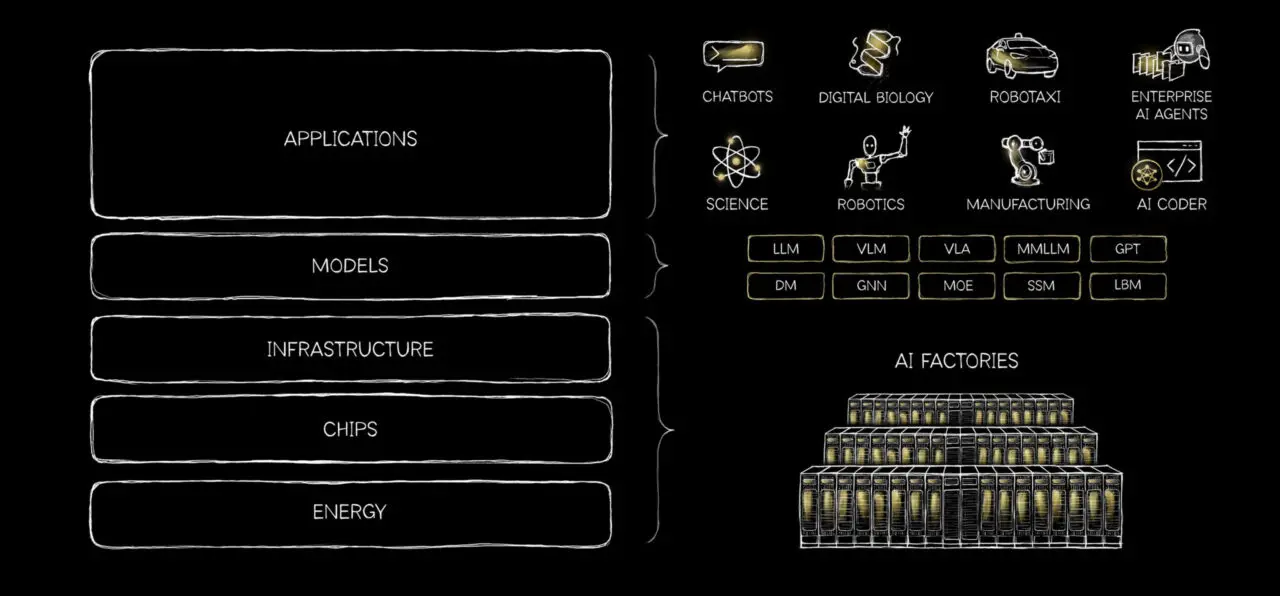
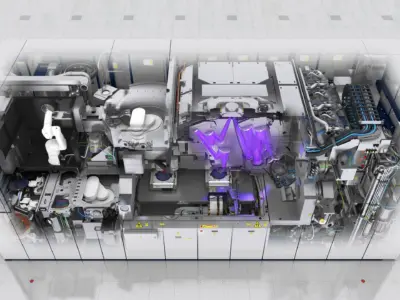
ASML High-NA EUV EXE:5200B achieves 175 wafers per hour throughput
The current production focus centers on the EXE:5000 and its successor, the EXE:5200B. These High-NA EUV systems operate at a 0.55 numerical aperture, which represents a major step up from the standard 0.33 NA Low-NA machines. The EXE:5000 began shipments in the fourth quarter of 2023, while the more advanced EXE:5200B reached customers in the fourth quarter of 2025.
Spec comparison
| Spec | EXE:5000 | EXE:5200B |
|---|---|---|
| Numerical Aperture | 0.55 NA | 0.55 NA |
| Throughput | 110 WpH | 175 WpH |
| Laser Source | Standard | 1000W |
| First Shipment | Q4 2023 | Q4 2025 |
Throughput is a critical metric for these lithography tools, and ASML has delivered substantial gains in this area. The EXE:5200B utilizes a 1000W laser source to achieve a throughput of 175 wafers per hour. This performance is a significant increase over the 110 wafers per hour capability of the earlier EXE:5000 model. By the end of 2025, ASML reported processing 500,000 wafers using High-NA technology.
High-NA EUV technology simplifies the manufacturing process by reducing the number of exposure passes required. ASML states that moving from 0.33 NA to 0.55 NA High-NA EUV cuts the necessary exposures from three down to one. This reduction also applies to the number of steps in the mask process, which improves efficiency. The company expects Hyper-NA EUV systems with a numerical aperture greater than 0.75 to reach high-volume manufacturing around 2033.
ASML executives highlighted the steady progress toward high-volume manufacturing during recent industry presentations. Chris De Ruiter noted that customer results for the 5000 and 5200B models are building strong momentum for future production. Jos Benschop indicated that the industry likely needs to take the next step in the second half of the next decade to maintain the roadmap. The company aims to make Hyper-NA EUV affordable eventually, despite the high initial costs of the technology.
ASML continues to refine its EUV lithography capabilities to support the scaling of advanced semiconductor nodes. The transition from Low-NA to High-NA and eventually to Hyper-NA EUV provides a clear path for future chip manufacturing. These tools are essential for producing the high-performance processors that power modern AI infrastructure and computing systems.
Discussion
0 comments
Log in to join the thread with a thoughtful take, question, or correction.