
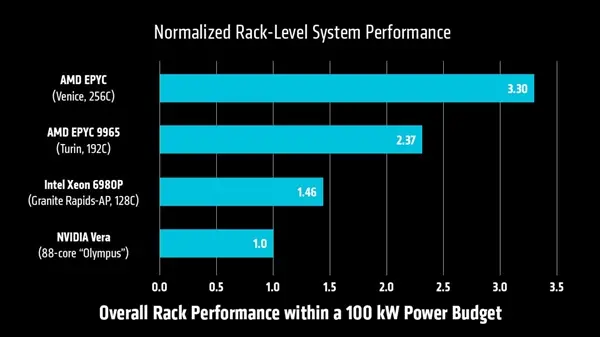
AMD released official performance data for its next-generation server processor, codenamed Venice. The chip uses a 2nm process and the Zen6 CPU architecture. This announcement marks a major shift in core density for high-end data center workloads.
Venice achieves a SPEC2017 score of 3.30 while maintaining fixed power limits compared to competing designs.
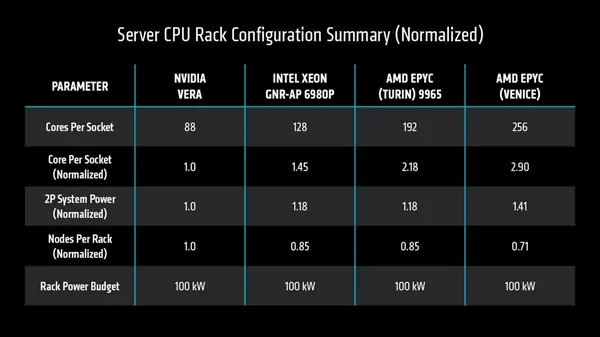
Venice targets the enterprise market with a base configuration of 256 cores and 512 threads. This setup doubles the thread count compared to standard server designs while pushing past the previous generation's 192-core limit. The design emphasizes high-throughput processing for multi-core workloads rather than optimizing individual thread performance.
AMD measured performance using SPEC2017 benchmarks at a fixed 100KW rack power draw. Venice scored 3.30 points on this scale, using NVIDIA Vera as a baseline reference of 1.0. The test results show the chip delivers roughly three times more computational throughput than the competing ARM-based design.
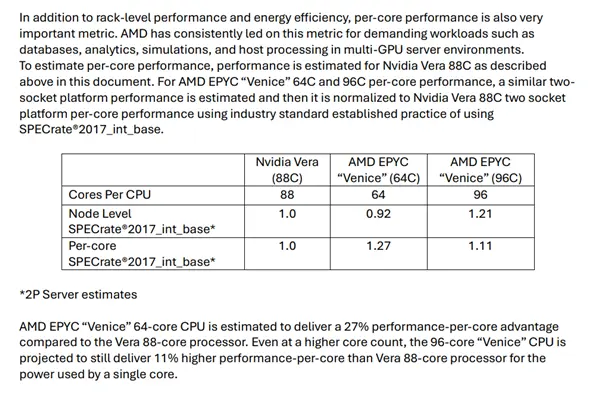
Per-core analysis reveals Zen6 holds a 27% performance advantage over the 88-core ARM variant. A hypothetical 96-core configuration narrows that gap to an 11% lead. The benchmark results demonstrate consistent performance gains relative to power consumption as the core count rises from 192 to 256 cores.
The processor outperforms Intel's Xeon 6980P by more than two times under identical testing conditions. The processor is designed to handle large-scale parallel workloads, including machine learning inference and intensive data analysis. Performance was measured using standard 100KW rack power consumption limits, indicating compatibility with conventional data center environments.
Previous generation processors offered fewer cores, resulting in lower aggregate performance compared to this new Zen6 configuration. The increased core density is enabled by the transition to a 2nm process, which supports higher thread counts within the specified power limits. The higher core density allows for greater processing capacity per server, potentially reducing the number of machines required for large-scale computing tasks.

Discussion
0 comments
Log in to join the thread with a thoughtful take, question, or correction.