
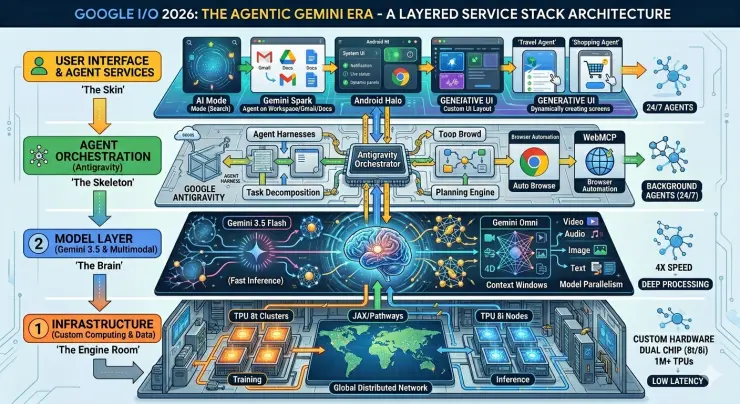
Google unveiled its next-generation TPU v8 infrastructure during the Google I/O 2026 keynote, which took place on May 19-20, 2026. The new hardware connects over one million nodes through the Virgo network to support global distributed learning workloads.
New hardware connects over one million nodes through the Virgo network to support global distributed learning workloads.
The company introduced a dual-chip strategy for its AI accelerators. Google deployed TPU 8t chips specifically designed for training large models and released TPU 8i units optimized for real-time inference and serving tasks.
Software announcements focused heavily on agent orchestration and multimodal capabilities. Gemini 3.5 Flash delivers output four times faster than previous versions to support complex workflows, while Gemini Omni Flash adds world model understanding of physics and kinematics for native video generation.
Google also showcased new platforms designed to manage autonomous software agents. Google Antigravity 2.0 provides orchestration tools for long-term tasks, and Agent Commerce enables automated browsing and payments through the AP2 protocol. Android HALO integrates real-time visual support into the OS environment, while Gemini Spark operates as a personal assistant within Chrome and Workspace.
Google Stitch generates customized dynamic dashboards in real time based on agent-planned tasks. The vendor has not confirmed specific launch windows for these software features.

Discussion
0 comments
Log in to join the thread with a thoughtful take, question, or correction.