
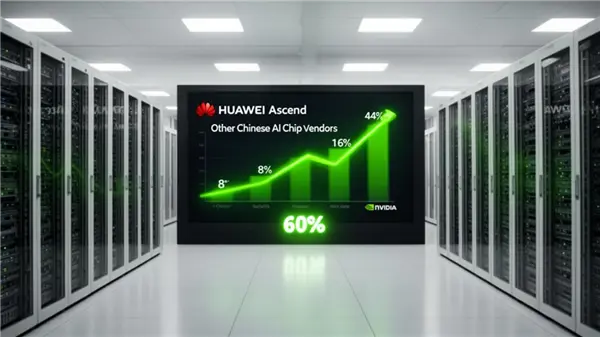
Domestic AI accelerator vendors in China have captured more than 60 percent of the local market, according to predictions from Bernstein Research. This shift marks a significant decline for NVIDIA, whose market share in the region has dropped to 8 percent from 95 percent three years ago. The changing landscape reflects a broader transition toward locally developed hardware solutions for artificial intelligence workloads.
Local vendors capture majority of market while NVIDIA share plummets
Huawei has positioned its Ascend 950PR chip as a strong competitor, claiming inference performance three times that of the NVIDIA H20. Cambricon reports that its Siyuan 370 offers equivalent compute power at one-third the price of the NVIDIA A10. The company forecasts shipments of 300,000 Siyuan 590 units in 2026. Hygon states its Deep Computing No.2 achieves 80 percent of the AI training efficiency of the NVIDIA A100. Moore Threads lists its MTT S5000 at 1000 TFLOPS of dense compute using its fourth-generation MUSA architecture.
Market analysts predict that Huawei Ascend will hold 50 percent of the Chinese AI chip market by 2026. These figures remain projections from authoritative institutions rather than confirmed historical data. Moore Threads has confirmed that its MTT S5000 completed adaptation for China Mobile's Jiutian 35B large model. The company highlights this compatibility as evidence of its growing role in the domestic ecosystem.
Industry reports indicate that 2025 China AI accelerator shipments reached approximately 4 million units. Domestic vendors delivered 1.65 million of those units, accounting for a 41 percent share of the total volume. This baseline demonstrates the rapid scaling of local manufacturing capabilities over the past year. The gap between current realized shipments and future market share predictions highlights the aggressive growth targets set by domestic chipmakers.
Discussion
0 comments
Log in to join the thread with a thoughtful take, question, or correction.