
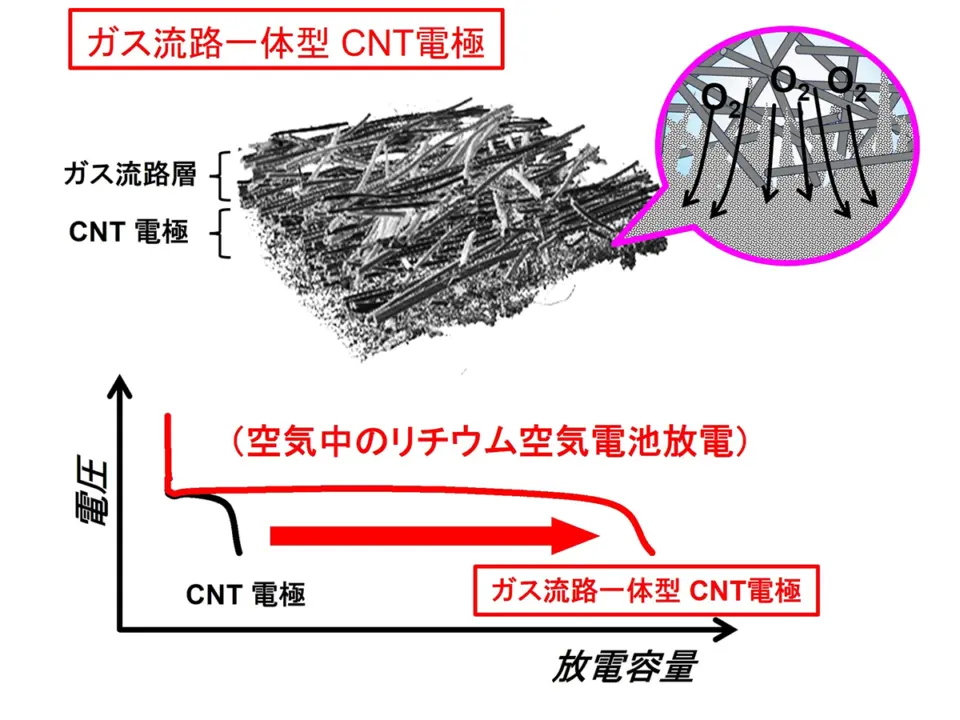
Researchers at Japan's National Institute for Materials Science (NIMS) have developed a lithium-air battery electrode that operates in ambient air. The team claims this is the first demonstration of a true lithium-air battery achieving practical power output using atmospheric oxygen.
CNT-CP electrode prevents deactivation
The key innovation is a carbon nanotube-carbon paper (CNT-CP) electrode that continuously intakes oxygen, preventing electrode deactivation. In tests, the battery delivered a capacity of 1.6 Ah at a current of 0.1 A in ambient air. It achieved an energy density of 740 Wh/kg and a power density of 48 W/kg.
Specifications
- Capacity: 1.6 Ah
- Energy density: 740 Wh/kg
- Power density: 48 W/kg
- Current: 0.1 A
Lithium-air batteries have long been pursued for their potential to store far more energy than conventional lithium-ion cells. By using oxygen from the air, they could dramatically reduce battery weight. However, previous designs suffered from electrode degradation when exposed to ambient air. The NIMS electrode appears to overcome that hurdle.
NIMS has not announced a timeline for commercialization. The research was published in the journal Science and Technology of Advanced Materials.



Discussion
0 comments
Log in to join the thread with a thoughtful take, question, or correction.