
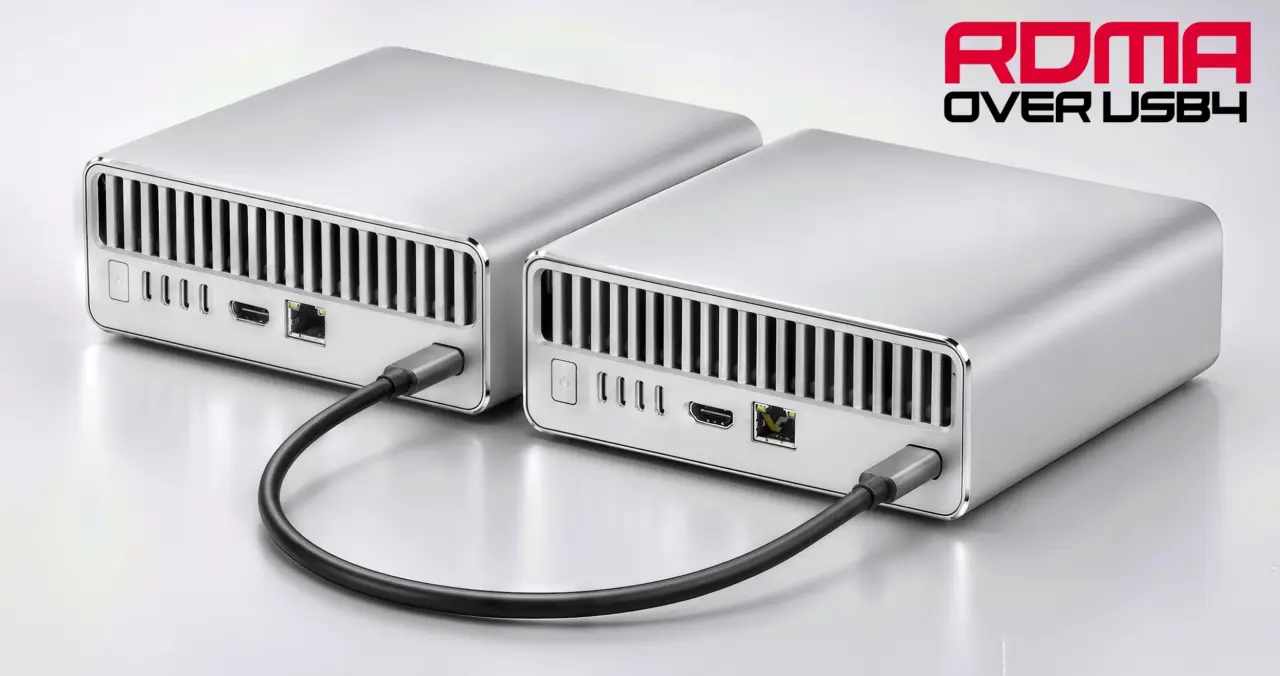
Microsoft is making changes to Windows to enable RDMA over USB4. With this change, users will be able to connect multiple computers together to run a single local AI model. Why is this important?
Windows update enables distributed local AI by pooling PC resources over USB4
It means that people with lower-end hardware can get more processing power by joining together the resources of nearby machines. You'll be able to treat connected computers as a single bigger compute device to do big jobs.
Specifically, the changes are being made to Windows and the USB4 interface. This is the physical connection between the computers. RDMA stands for Remote Direct Memory Access.
What that does is pass data between memory spaces directly without a ton of CPU work. That lowers latency and gives more of the CPU processing cycles to actually working on the AI task.
The main technical points are that they are changing the USB4 protocol. This gives you enough bandwidth to be able to do this distributed computing. The ability to have multiple PCs share resources for a single local AI model. Distributed processing for local AI workloads over USB4 connected PCs.
This gives you more capability in a typical desktop PC environment, and you can do it without the need for an expensive single-PC solution. It is a way to upgrade AI capabilities by connecting more PCs together. If you have some extra PCs lying around, this makes it so you can get them all to contribute to the same task.
USB 4 cables are expensive enough as it is. Adding latency overhead for distributed memory access seems like a recipe for instability.