

Microsoft's new RDMA over USB4 feature is making its way into Windows 11. It's a capability that lets you daisy chain multiple USB4 capable PCs together to share memory and GPU computing power to run your AI workloads locally. This is important because it allows you to take your normal mini PCs and turn them into a super powerful cluster.
Microsoft RDMA over USB4 cuts latency to 28-50 microseconds
It can be an affordable way to start running those large language models without investing in high-end server hardware. Now, we can see how it performs in the real world on AI tasks from initial testing by both AMD and Intel.
This technology avoids the CPU and kernel entirely with NetworkDirect to minimize communication overhead between systems. Microsoft says this technique leads to about a 4x reduction in round trip latency for small messages on the USB4 link, compared to regular Ethernet using that USB4 link. They're making it available as a developer preview in the Windows Insider Experimental channel, so we can get a head start on trying out this new feature before it's more widely available.
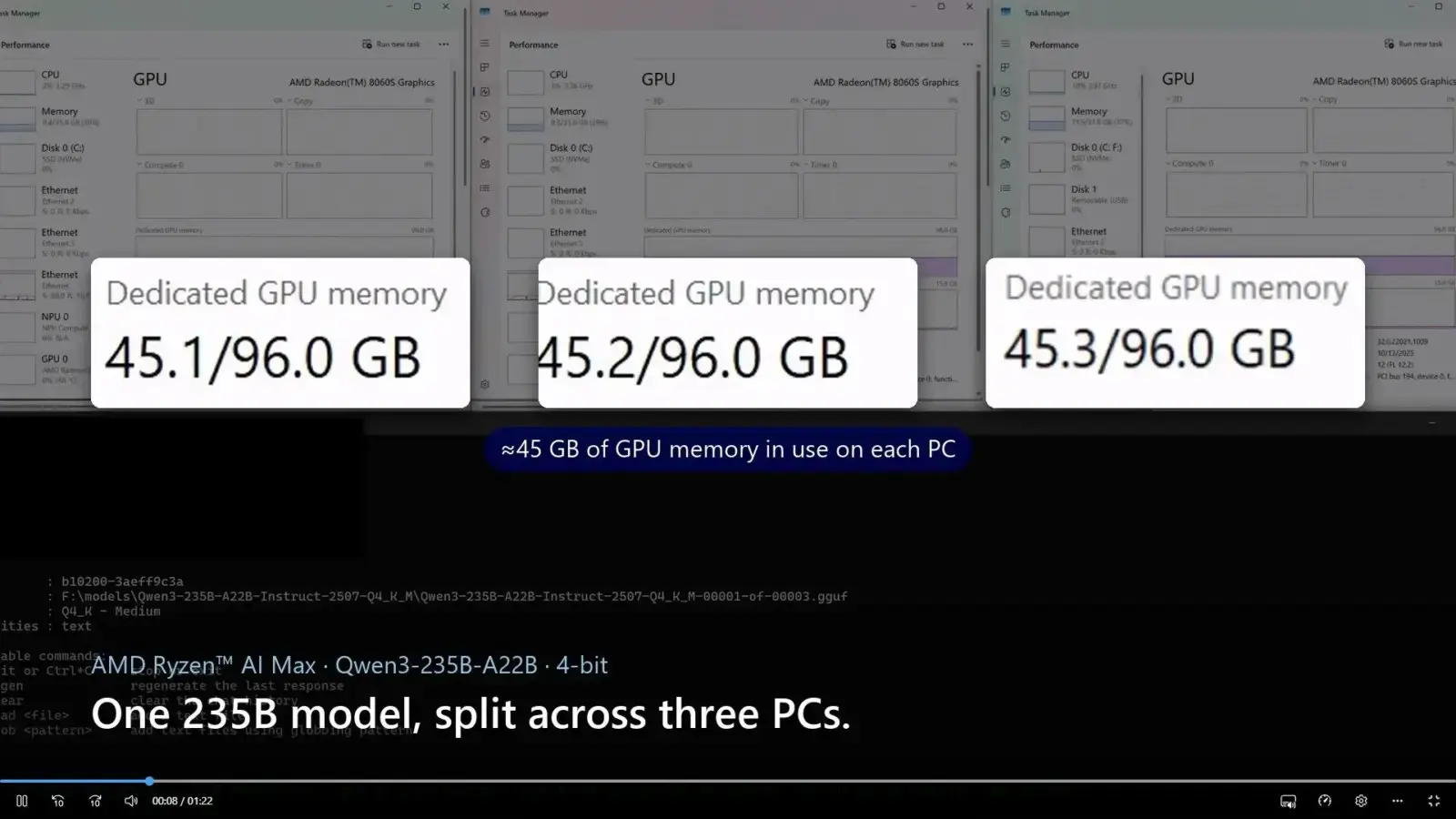
For an example use case, AMD showed off a three-mini PC cluster made of Ryzen AI Max based PCs with Radeon 8060S graphics and 128GB of unified memory each. They were able to run the Qwen3-235B-A22B model with 235B parameters at about 18.5 tokens/second, when running it in 4-bit quantization. Intel gave us a peek at their use case, which involved Core Ultra Series 3 systems with 64GB of memory per system.
They could run 49 tokens/sec on their three PC setup for the GPT-OSS-120B model. If they added a fourth PC, that number jumped to around 54 tokens/sec.
This will be off by default. You'll need to manually enable it using a registry setting. You also have to disable Secure Boot temporarily, as well as enable test signing.
So, it really makes the most sense for developers and enthusiasts, who are willing to tinker with their system security settings to get some extra performance. It's a great way to scale local AI inference out with existing hardware, without having to invest in specialized network hardware.
RDMA over USB4 gives you a new way to pool PC resources together to tackle those more complex AI models. It's available now as a developer preview for Windows Insiders, in the Experimental channel. Early tests give us some impressive latency savings and ways to scale it across different hardware setups, from both AMD and Intel.


Does this registry tweak allow memory pooling across different CPU architectures? The AMD cluster used Ryzen AI Max while Intel tested with Core Ultra Series 3 systems.
It should work as long as the USB4 controller exposes the necessary NetworkDirect interfaces. The latency drop to 28-50 microseconds suggests the bypass is handling the transport layer agnostic of the host processor. You just need consistent unified memory layouts.