
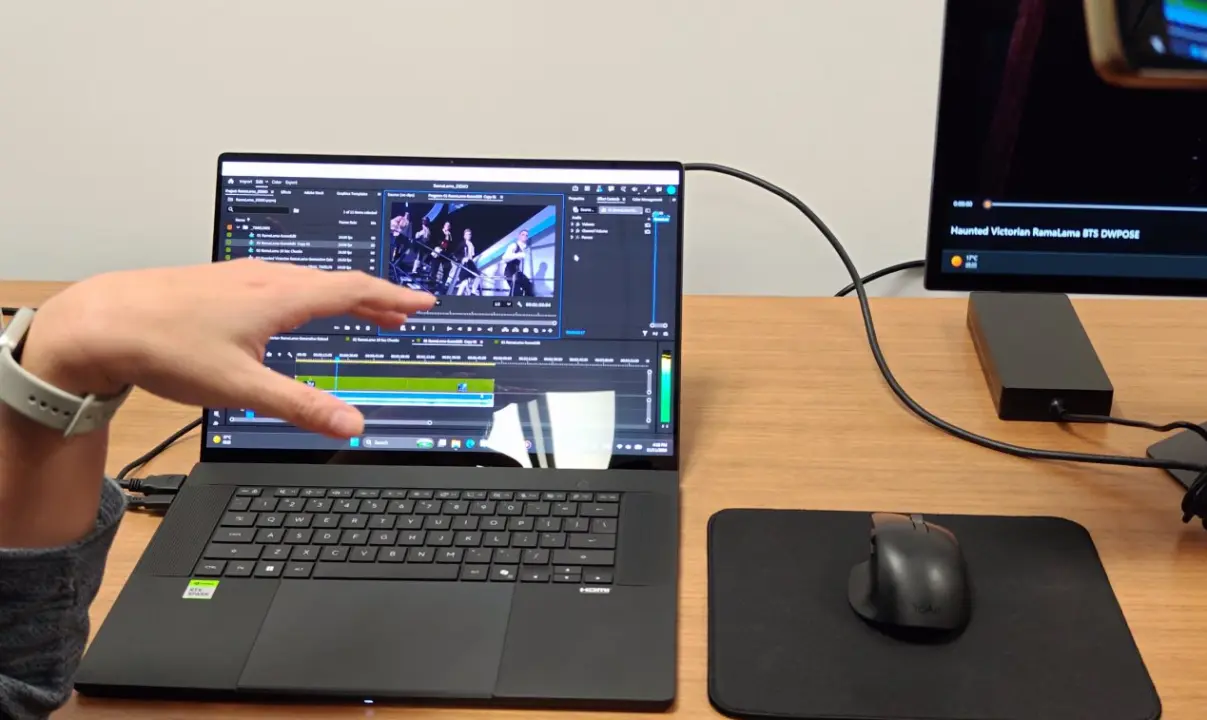
NVIDIA introduced RTX Spark, a small Windows PC offering desktop performance with top-tier AI and gaming capabilities. The significance of this launch lies in its ability to provide local processing for advanced language models and 3D rendering, bypassing cloud dependency. It is ideal for creators and gamers seeking robust on-device computing in a compact form.
Blackwell GPU and Grace CPU enable local AI and 3D rendering
The RTX Spark combines a Blackwell architecture GPU with a 20-core Grace CPU utilizing the Arm architecture. NVIDIA partnered with MediaTek to create this CPU, emphasizing seamless interaction between the CPU and GPU. This integration enables efficient execution of both high-demand AI processing and general PC applications.
Specifications
- GPU Architecture: Blackwell
- CPU: 20-core Grace CPU (Arm)
- Unified Memory: 128GB
- AI Compute: 1 PFLOP (FP4/NVFP4)
- Interconnect: NVLink-C2C, 600GB/s
RTX Spark includes 128GB of unified memory shared by both the GPU and CPU. These processors are connected through NVLink-C2C, offering a 600GB/s data transfer bandwidth. The system provides 1 PFLOP of AI computing power with FP4 and NVFP4 precision.
In a demonstration at the NVIDIA Shanghai Lab, the RTX Spark achieved a processing rate of 5616 tokens per second for the GPT-OSS 20B model. This is 3.5x faster than the AMD Ryzen AI Max+ 395 platform, which processed 1589 tokens per second. Furthermore, the RTX Spark generated FLUX.2 images in 25.8 seconds, while the AMD counterpart took 66.3 seconds.
The RTX Spark can handle Unreal Engine 5 scenes exceeding 90GB and process the Qwen3.8 27B model with a speed range of 55-60 tokens per second. We have been closely following the developments of RTX Spark, check out our previous coverage on NVIDIA RTX Spark Laptops Confirm AAA.
NVIDIA mentioned that the laptop model of RTX Spark was released a month ago before this event. On the day of its release, it supports hundreds of popular games. NVIDIA promotes the RTX Spark as a tool for local AI agents and creative projects that demand high processing power.
Comments (0)