
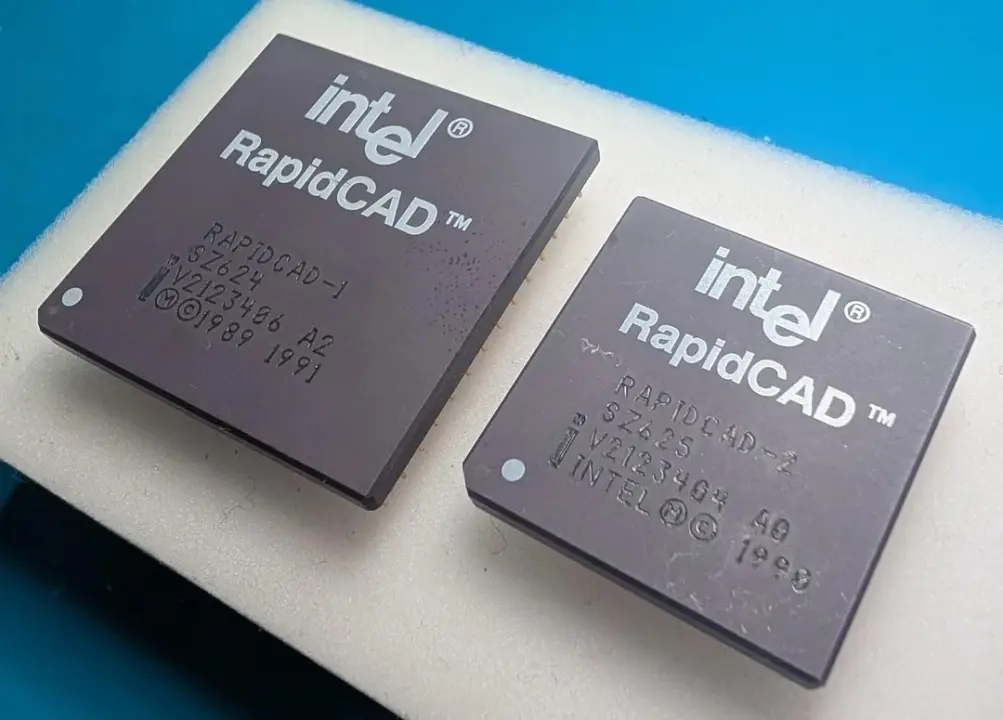
Intel rapidCAD was unusual. It was a way to upgrade your 386DX without changing your motherboard. Here's a two chip solution that let you run CAD and scientific applications on your older hardware. It's a focused approach to solve a problem for people that needed the FP horsepower, but couldn't jump up and replace the entire system.
A two-chip upgrade solution for 386DX systems
This upgrade was a 2 piece of silicon. First you have a bigger chip that goes in the 80386DX socket called RapidCAD-1. It has a 486DX style core inside, but not the 8KB L1 cache that's present in 486DX's. Then you have RapidCAD-2 which is an 80387 math coprocessor replacement.
Specifications
- RapidCAD-1 Package: 132-pin PGA
- RapidCAD-1 Socket: 80386DX processor socket
- RapidCAD-2 Package: 68-pin PGA
- RapidCAD-2 Socket: 80387 math coprocessor socket
- RapidCAD-1 Core: 486DX-derived core without L1 cache
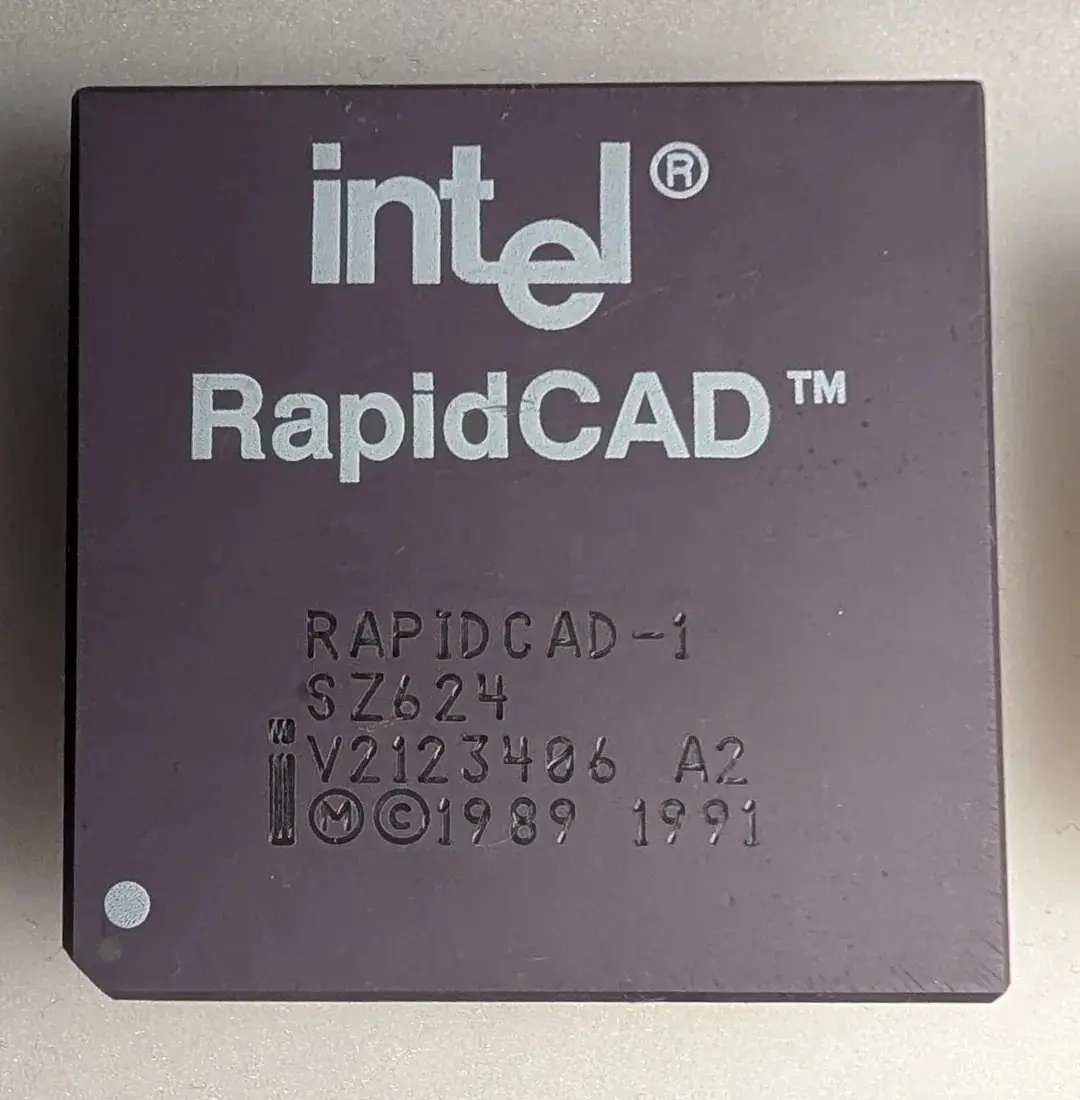
RapidCAD-1 handles integer processing and has a built in floating point unit. RapidCAD-2 takes care of the FP error signals to make it compatible with 386DX's. These two chips could work together as a holistic CPU upgrade.
Performance-wise it had a small (6%) integer speed boost over a regular 386DX-33. However it got you a big (~70%) boost in FP over the Intel 387 coprocessor. It was optimized for engineering use cases where you're doing math calculations to be productive.
The Intel RapidCAD was a transition piece from 386 to 486 style performance. It demonstrated that you can get a huge FP boost from partially integrated cores. And of course it's a niche historical solution for the problem of cost to upgrade to early 486's.
A 70% floating point bump for just swapping the coprocessor and a stripped 486 core is wild. That L1 cache removal was a clever cost cut to keep the price down for engineering firms stuck on 386DX boards.
Did anyone actually get one installed without frying their motherboard? The 132 pin PGA looks huge compared to the standard 387 socket. I would be terrified to touch that hardware.
It was a niche solution. The integer speed was only 6 percent higher than a standard 386DX 33. This was purely for the math heavy CAD workloads where the 387 was the bottleneck.