
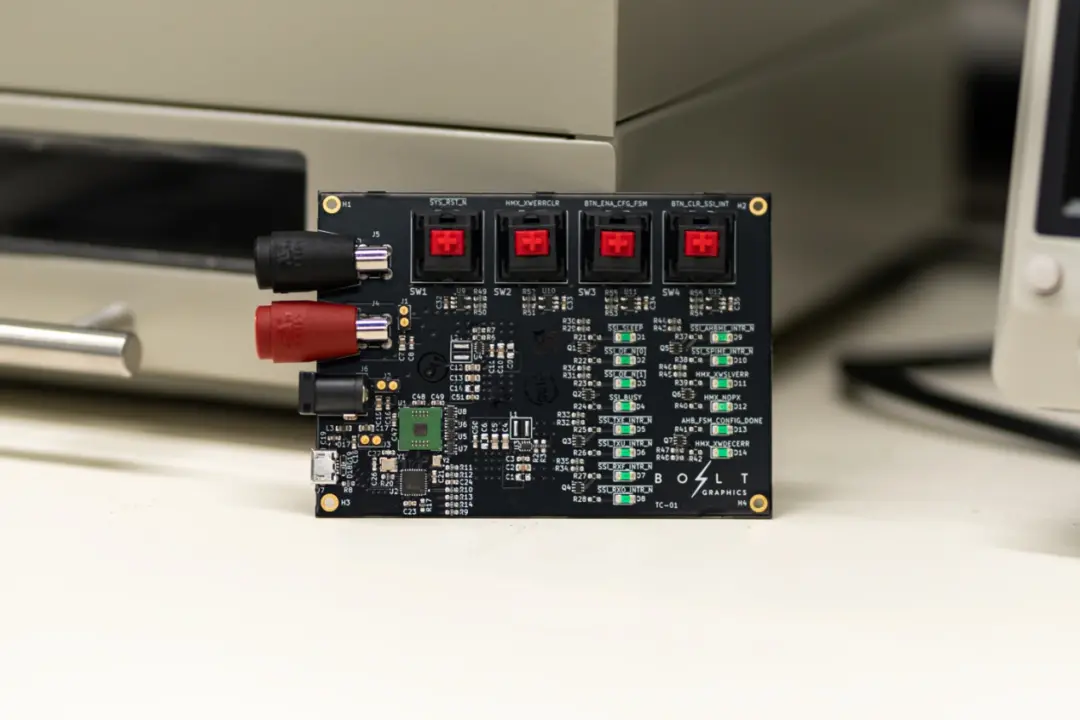
For a competitor looking to shake up the landscape, Bolt Graphics has finalized debugging on its Zeus architecture test chip of its GPU. This is important, as it's a development that brings a specialized hardware solution to the table for electromagnetic simulations. That's a niche use-case, but also extremely important for engineering / scientific computing. In this news release, they're clearly progressing from design ideas to the reality of silicon, although it's still going to be years before we'll see mass production.
Bolt Graphics completes debugging of Zeus GPU test chip with zero defects
The Zeus chip is the first commercial GPU architecture for Bolt Graphics. It's meant to perform complex physics simulations natively as hardware. The A0 stepping of the test chip we saw today has a dedicated block for Maxwell's equation solving.
Specifications
- Process Node: TSMC 12nm (Test Chip), TSMC N5P (Commercial)
- Die Size: 6mm²
- Power Consumption: 1.4W
- Stepping: A0
- Key Feature: Dedicated electromagnetic simulation hardware (Maxwell's equations)
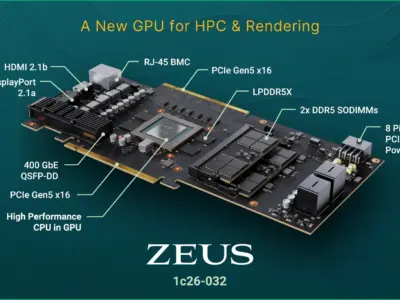
This specialized hardware orientation makes Zeus unique when compared to traditional general purpose graphics chips that use software libraries for similar purposes. The goal is to take this architecture and move it over to a commercial offering with a more modern manufacturing process.
Speaking of the test chip itself, it's extremely small and power-efficient. It's only 6mm^2 of die area on TSMC 12nm process. Power draw is only 1.4W.
No functional issues detected on the initial test. The commercial version will transition to TSMC N5P process for better performance. This will also help them avoid competing for wafer capacity in the AI chip market. This seems to be a more established but still capable process, so it's focused on getting to stability / yield for the commercial launch.
The performance they're claiming for Zeus 1C configuration is a 2.5x speedup over RTX 5090 in path tracing. For the 4C configuration, it's 10x speedup over that benchmark. For FP64 electromagnetic simulations, they claim 300x speedup over NVIDIA B200 for 4C configuration.
These claims are straight from the company. Keep in mind it's for prototype stuff. We haven't seen a third party performance claim for mass production units. You can see the performance delta and how efficient these specialized architectures can be for solving specific math problems.
Bolt Graphics aims for developer access to their Zeus platform in Q1 2027. First customer deliveries are planned for end of 2027. As for mass production of PCIe add-in cards and server deployments, that's aimed for 2028.
This gives Bolt Graphics some time to make things converge on the design side and get software ecosystem in place before actually getting it out to users. If you're a buyer for electromagnetic simulations, just remember this is still going to be a few years out from being generally available.
Discussion
0 comments
Log in to join the thread with a thoughtful take, question, or correction.