
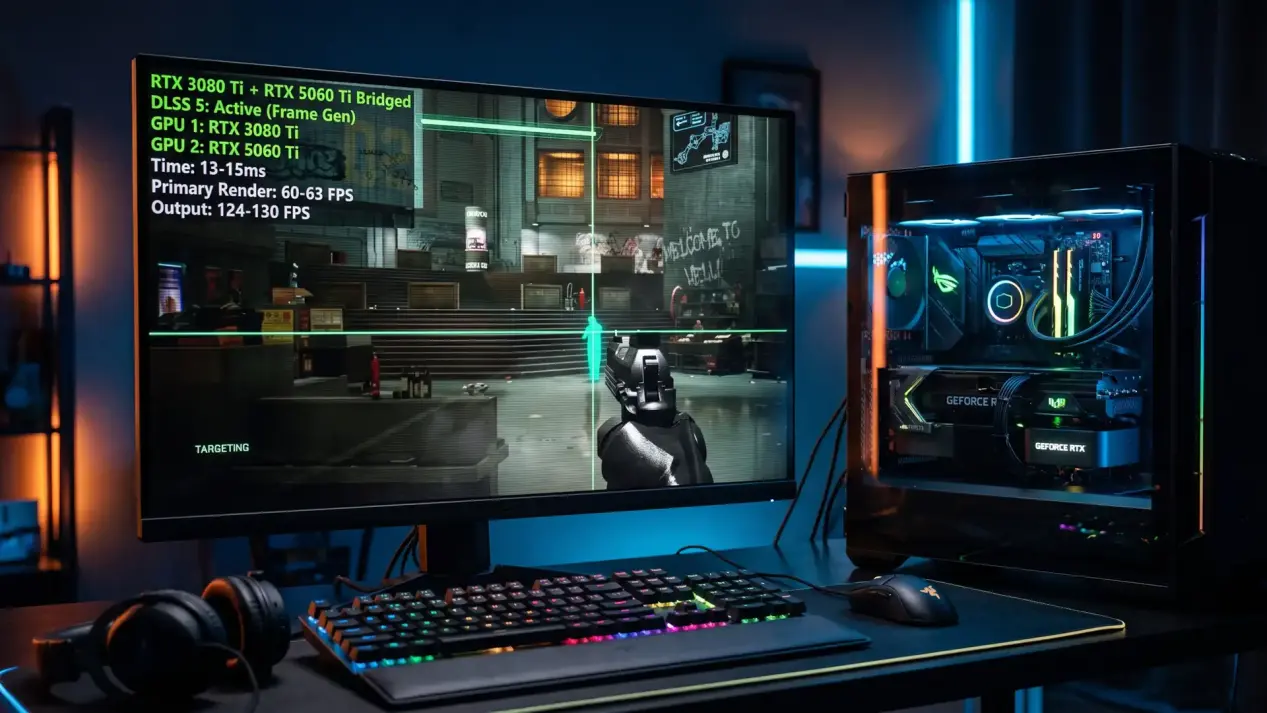
Developer Drknight71 released version 0.90 of GPU Bridge, an experimental tool that splits graphics processing across two separate cards in the same PC. This approach matters because it offers a way to push frame rates higher without relying on a single, expensive flagship GPU. Users can potentially double their 2K performance by coordinating a primary card with a secondary processor dedicated to neural rendering tasks.
Developer Drknight71 splits rendering pipeline across two graphics cards to boost performance
The software operates by dividing the rendering pipeline between a primary GeForce RTX 3080 Ti and a secondary GeForce RTX 5060 Ti. The primary card handles native geometry and base rendering, while the secondary card manages DLSS 5 neural rendering. Drknight71 built this project on Marcelo Guibout's Neural Coprocessor concept, which aims to split the graphics pipeline across two GPUs in the same workstation to work together. The system runs on top of Super Resolution, Frame Generation, and Ray Reconstruction to refine lighting, shadows, materials, and details in real-time.
- Software Version: v0.90
- Primary GPU: GeForce RTX 3080 Ti
- Secondary GPU: GeForce RTX 5060 Ti
- Test Resolution: 2560×1440 (2K)
- Test Game: RoboCop: Rogue City – Unfinished Business
Drknight71 noted that this technology is not a replacement for super-resolution scaling, but runs on top of Super Resolution, Frame Generation, and Ray Reconstruction to refine lighting, shadows, materials, and details in real-time. In tests running RoboCop: Rogue City at 2560×1440 resolution, the primary GPU maintained a base render of 60-63 FPS. The secondary GPU processed DLSS 5 neural rendering with a latency of 13-15 ms. This combination pushed the final frame rate to 124-130 FPS.
The project uses AI-generated code and is experimental, so it is not affiliated with NVIDIA or AMD. Users are advised to test the software only in single-player games that do not use anti-cheat measures. The existence of the GeForce RTX 5060 Ti as a consumer product remains uncertain, as NVIDIA had not officially released such a card as of the announcement date. Similarly, DLSS 5 is not yet a publicly released standard feature for consumer cards, suggesting the test environment may involve experimental or internal builds.
Drknight71 confirmed that the dual-GPU setup doubles 2K frame rate to 124-130 FPS using DLSS 5 neural rendering on the secondary GPU. The software provides a concrete method for boosting performance in supported titles, though it requires specific hardware configurations and carries stability risks. Buyers interested in experimental dual-GPU setups should proceed with caution and stick to non-competitive gaming scenarios.

Discussion
0 comments
Log in to join the thread with a thoughtful take, question, or correction.