
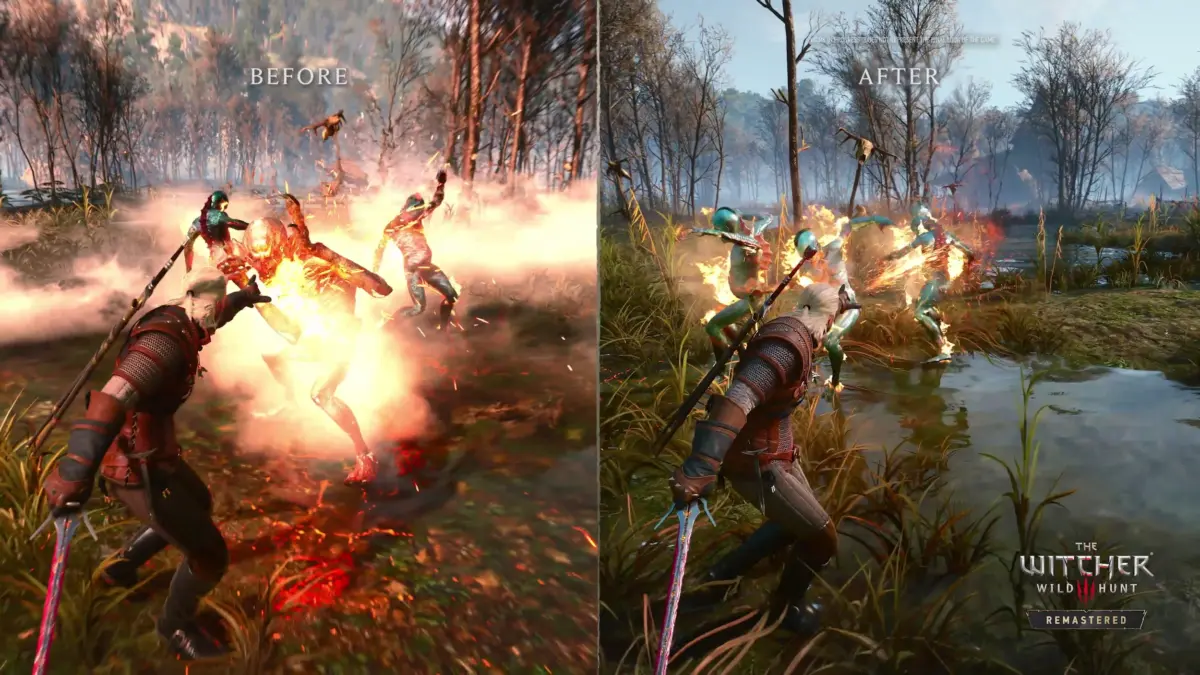
CD Projekt RED has updated the PC requirements for The Witcher 3: Wild Hunt Remastered, a change that significantly raises the hardware bar for players seeking the game's most advanced visual mode. The studio now mandates the GeForce RTX 5080 to run path tracing at 4K resolution with 60 frames per second, a target that forces users to upgrade to the latest high-end graphics cards. This requirement matters because the path tracing feature, which combines ray tracing with upscaling and frame generation, represents the visual peak of the remaster and demands substantial computational power to maintain smooth performance.
Updated PC requirements mandate RTX 5080 and 24GB RAM for path tracing mode
The remastered version of the game launches globally on September 29 as a free upgrade for existing owners, bringing these updated technical specifications into immediate focus for the player base. CD Projekt RED has structured the requirements to support a wide range of hardware, but the path tracing configuration sits at the top of the hierarchy. Players who wish to experience the full visual fidelity of the remaster must align their systems with the new high-end standards, while those content with lower settings have more flexibility in their hardware choices.
- Path Tracing GPU: RTX 5080
- Path Tracing CPU: Core i9-13900K / Ryzen 7 9800X3D
- Path Tracing RAM: 24GB
- Path Tracing Target: 4K, 60 FPS
- Minimum GPU: GTX 1660 / RX 5500 XT / Arc A580
The path tracing configuration requires a minimum of 24GB of system memory and pairs the RTX 5080 with either an Intel Core i9-13900K or an AMD Ryzen 7 9800X3D processor. This specific CPU and RAM combination ensures that the system can handle the heavy data throughput required for real-time ray tracing calculations at high resolutions. The game utilizes upscaling technologies such as DLSS, FSR, and XeSS alongside frame generation to help achieve the 60 FPS target, but the base hardware requirements remain strict to support the underlying rendering engine.
For players who do not intend to use path tracing, the minimum requirements are considerably lower, allowing older hardware to run the game. The minimum GPU requirement is now the GeForce GTX 1660, the Radeon RX 5500 XT, or the Arc A580, all of which can achieve 60 FPS or higher at minimum settings according to the developer. However, the remaster enforces a mandatory SSD for storage and requires Windows 11 as the operating system, officially removing support for Windows 10. While CD Projekt RED notes that the game may still function on Windows 10, the studio no longer develops or tests the title on that older operating system, signaling a firm shift toward modern software standards.
The Witcher 3: Wild Hunt Remastered arrives on September 29 with these updated technical demands, setting a clear path for players to follow based on their visual preferences. Those seeking the highest fidelity must invest in an RTX 5080 and 24GB of RAM, while others can rely on entry-level cards like the GTX 1660 for standard performance. The removal of Windows 10 support and the mandatory SSD requirement apply to all configurations, ensuring a consistent baseline for storage speed and system compatibility across the board.



Discussion
0 comments
Log in to join the thread with a thoughtful take, question, or correction.