
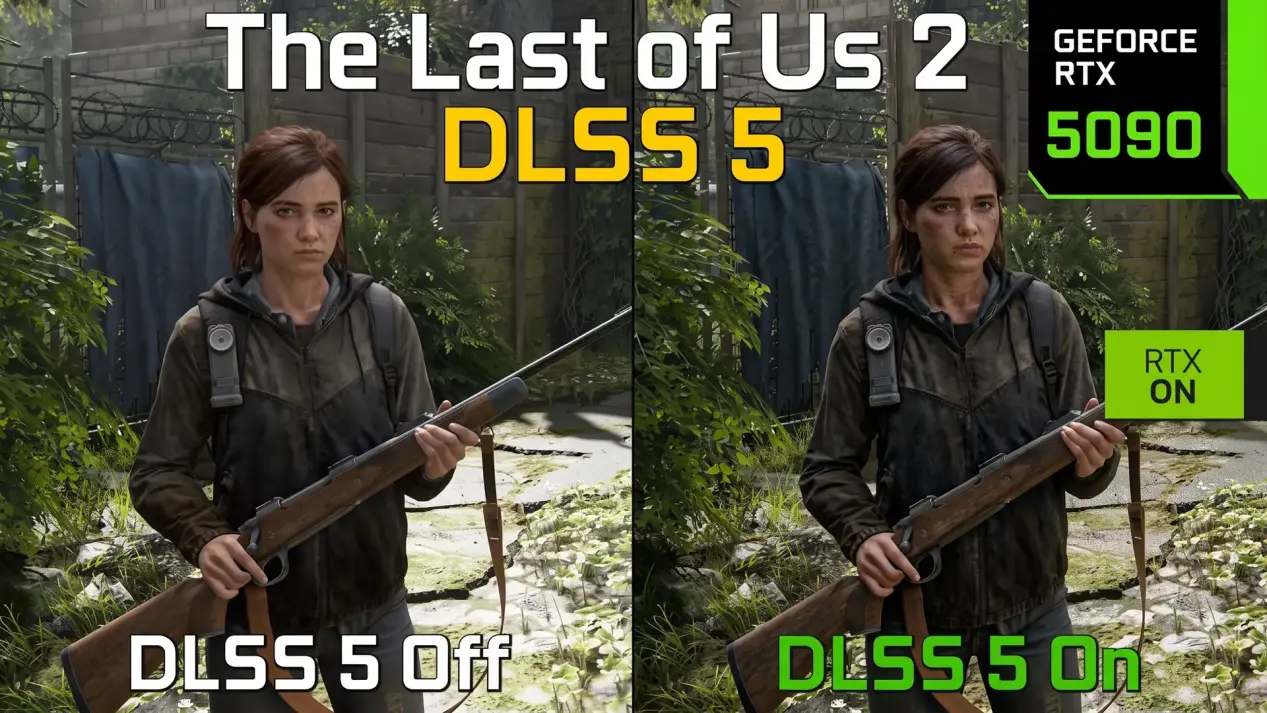
NVIDIA’s DLSS 5 neural rendering mode fundamentally shifts how the RTX 5090 handles frame generation, forcing buyers to weigh visual fidelity against raw performance. Our analysis of test data reveals that enabling this experimental feature cuts frame rates in half for demanding titles, a trade-off that directly impacts high-end gaming setups. Users relying on the RTX 5090 for maximum frame rates in CPU-intensive scenes must now account for a significant drop in throughput when this technology is active.
DLSS 5 neural rendering shifts workload to GPU, doubling power draw
The core of this change lies in how DLSS 5 redistributes computational workloads between the processor and the graphics card. According to test data from YouTube blogger Frozburn, enabling experimental NVIDIA DLSS 5 neural rendering in The Last of Us Part II PC version at 4K resolution and highest settings comes with a stunning performance cost: RTX 5090 frame rate halved from 285 FPS to 138 FPS, losing 147 frames. This shift moves processing tasks from the CPU to the GPU’s dedicated AI engine, altering the traditional balance of PC gaming hardware.
- DLSS 5 Frame Generation Impact: RTX 5090 frame rate dropped from 285 FPS to 138 FPS (loss of 147 FPS) in The Last of Us Part II at 4K Ultra settings
- GPU Power Consumption: Increased from 395W to 511W (absolute increase of 116W) with DLSS 5 enabled
- GPU Core Load: 99% load
- GPU Temperature: Increased from 46°C to 50°C
- VRAM Usage: Stable at 13.5GB
Performance metrics show a dramatic spike in GPU power consumption alongside the frame rate drop. The RTX 5090 draws 511W of power with DLSS 5 enabled, an increase of 116W from the 395W baseline. This surge pushes the GPU core to a 99% load and raises the chip temperature from 46°C to 50°C. Meanwhile, the CPU load drops from 50% to 35%, and its power consumption falls from 70W to 57W, confirming the workload transfer.
Visual quality improvements accompany these resource costs, as the technology aims to eliminate rendering artifacts. Frozburn noted that the feature achieves extreme visual fidelity by getting rid of sub-pixel flickering and aliasing in dense vegetation and character details. Video memory usage remained stable at 13.5GB throughout the test, indicating that the performance hit stems from computational intensity rather than memory bandwidth limits.
We looked at the last RTX 5090 update while tracking these performance shifts, noting recurring themes of balance and stability in high-end GPU deployments. The specific build version of The Last of Us Part II tested remains unconfirmed, as does the exact cooling solution used for the RTX 5090 in these benchmarks. These gaps leave some uncertainty around the thermal headroom required to sustain 511W draws in consumer systems.
The RTX 5090 delivers unmatched visual clarity with DLSS 5 enabled, but at the cost of halving frame rates in specific scenarios. Buyers prioritizing maximum FPS in CPU-bound games may need to disable the feature, while those seeking the highest possible image quality will accept the performance penalty. The technology confirms a clear architectural shift toward GPU-centric AI rendering in next-generation gaming.


Discussion
0 comments
Log in to join the thread with a thoughtful take, question, or correction.