

Developers have successfully ported NVIDIA's DLSS 5 neural rendering pipeline to Apple Silicon hardware, marking a technical cross-architecture breakthrough. This experiment reveals the severe performance penalties when forcing NVIDIA's AI rendering technology onto Apple's M5 Pro chip. The port demonstrates that while the software can run, it is practically unusable for gaming due to extreme latency and frame rate drops. Readers interested in Apple gaming or cross-platform graphics should note that this port serves as a technical feasibility study rather than a viable gaming solution.
Porting NVIDIA AI rendering to Apple Silicon reveals severe performance penalties
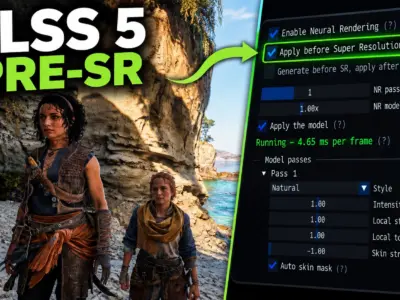
The project utilizes the M5 Pro chip, which features a 16-core GPU configuration. Developers @iamwavecut and @Mappsnet7 executed the port using Apple's native Metal graphics API. They paired the Metal bridge with Game Porting Toolkit version 4.0b2 to facilitate the translation of NVIDIA's DirectX-based pipeline. This setup allowed the team to run the DLSS 5 software stack on Apple's custom silicon without native driver support.
- DLSS 5 FPS on Apple M5 Pro: 2.32 FPS
- System Input Latency: 240ms
- GPU Configuration: 16-core GPU
- Resolution: 1440p
- Precision Architecture: FP16 (compensating for missing FP8)
DLSS 5 relies heavily on FP8 precision for its neural rendering calculations. Apple M5 Pro lacks dedicated FP8 hardware compute units, which forces the system to use FP16 instructions as a compromise. This architectural mismatch doubles the computational load required to process the same rendering tasks. The hardware limitation directly causes the severe performance bottleneck observed in testing.
Testing at 1440p resolution resulted in an average frame rate of just 2.32 FPS. System input latency spiked to 240 milliseconds, rendering the experience unresponsive for interactive gaming. The source title describes the result as running but only at 2 frames with high latency. These metrics confirm that the port is not suitable for practical use, despite the successful technical integration.
We looked at the last DLSS 5 update while tracking NVIDIA launches. That previous coverage highlighted balance and stability themes that remain relevant to this cross-platform experiment. The current port underscores the significant hardware gaps between NVIDIA's native architecture and Apple's current generation chips.
This port confirms that DLSS 5 cannot function effectively on Apple Silicon without native FP8 support. The 2.32 FPS and 240ms latency figures provide concrete evidence of the hardware limitations. Developers have proven the software can execute, but the performance cost makes it irrelevant for end users.

Discussion
0 comments
Log in to join the thread with a thoughtful take, question, or correction.