
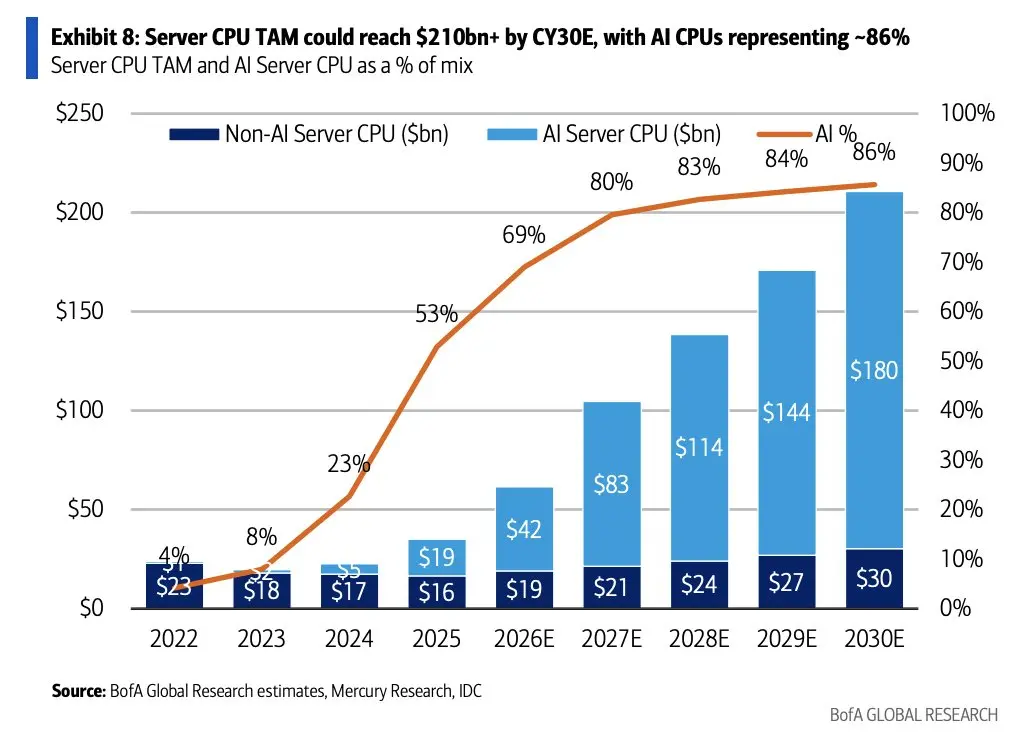
The server CPU market is undergoing a structural shift that will redefine hardware investments for the next decade. Analysts project the total addressable market will exceed $210 billion by 2030, driven almost entirely by artificial intelligence workloads. This expansion means data center operators must pivot their procurement strategies toward AI-optimized silicon. The era of general-purpose server dominance is ending as specialized AI chips claim the majority of revenue.
AI processors drive market growth while Intel loses unit share to AMD and ARM
Intel faces a significant challenge in maintaining its historical leadership as the market fragments across multiple architectures. The company's server CPU unit market share is estimated to drop from 62% to 35.8% by 2030. This decline reflects the rapid adoption of alternative designs from AMD and ARM-based solution providers. AMD is projected to capture approximately 31% of the market, while ARM vendors target a combined 30-35% share. These shifts indicate a highly competitive landscape where x86 architecture must justify its position against specialized competitors.
AI-specific server CPUs are expected to represent 86% of the total server CPU market share by 2030. Shipments of these AI-focused processors are estimated to reach 82 million units, up from 38 million in 2026. Intel is gaining revenue market share in servers despite losing unit share, driven by higher chip prices and supply constraints. This dynamic suggests that Intel is prioritizing premium, high-margin products over volume sales in the server segment. The company's ability to maintain revenue growth depends on its capacity to deliver high-value AI accelerators.
Intel shows signs of client-side recovery through DDR4 platform promotions and extended Raptor Lake lifecycles. These strategies aim to stabilize revenue in the consumer and enterprise PC markets while the server division navigates architectural changes. The broader industry trend points toward x86 retaining a strong position in the AI CPU wave through 2030. Data centers will continue to rely on x86 ecosystems for compatibility and software maturity. This reliance provides a buffer for Intel and AMD as ARM-based solutions gain traction in specific niches.
Discussion
0 comments
Log in to join the thread with a thoughtful take, question, or correction.