
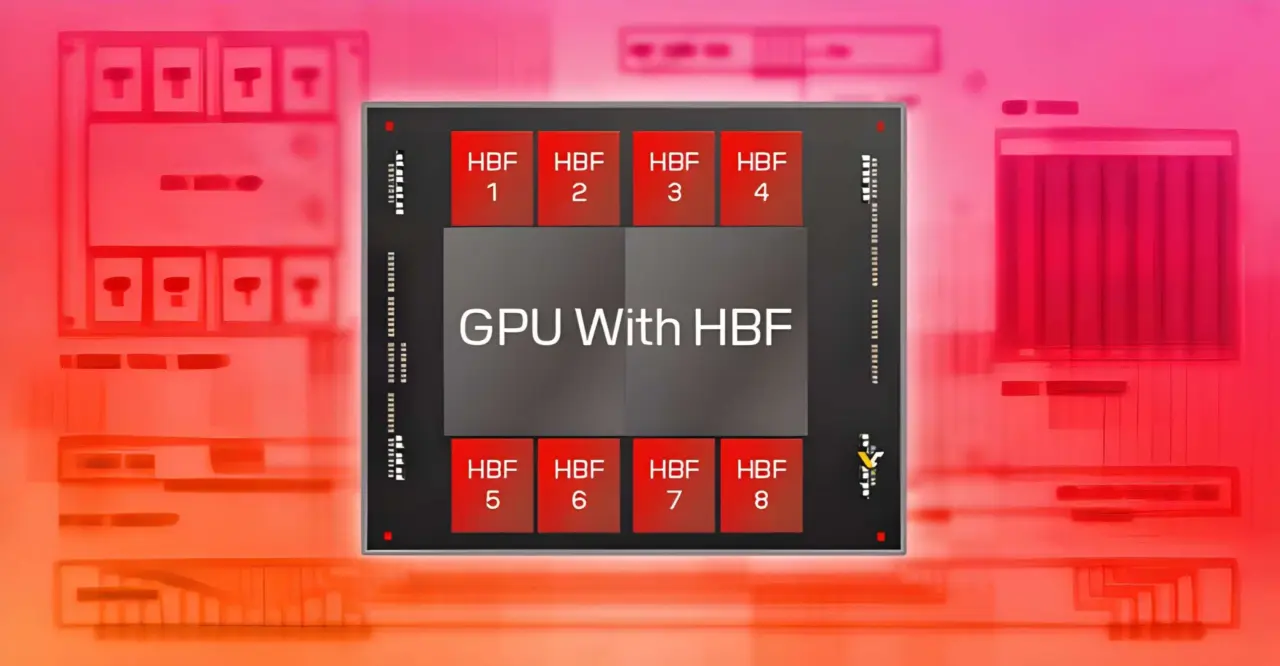
SanDisk’s August 2026 investor day presentation introduced High-Bandwidth Flash (HBF), a NAND-based storage technology designed to offload AI model data from expensive GPU memory. This shift matters because it promises to reduce hardware costs for AI infrastructure by using cheaper flash instead of high-bandwidth memory. However, the announcement sparked immediate backlash from technical observers who argued the company misrepresented key performance metrics. Readers should note that the technology remains in development with a commercial rollout targeted for 2028 or 2029.
Critics argue SanDisk used outdated benchmarks to highlight HBF efficiency
The HBF product aims to provide 512GB of storage capacity with a bandwidth range of 0.4TB/s to 3TB/s. SanDisk developed this technology in partnership with SK hynix to address the growing demand for KV cache offloading in large language models. The company used parallelism to achieve these cumulative speeds, claiming thousands of parallel reads can overcome the inherent slowness of NAND compared to DRAM. This approach positions HBF as a potential middle ground between traditional SSDs and volatile HBM stacks.
- HBF Storage Capacity: 512GB
- HBF Bandwidth: 0.4TB/s to 3TB/s
- HBM Bandwidth (SanDisk Claim): 12.8 TB/s
- HBM4E Bandwidth (Competitor Spec): 32 TB/s
- HBF Commercial Rollout: 2028/2029
Critics point out that SanDisk’s performance claims rely on outdated comparison standards. The company fixed the bandwidth of both HBM and HBF stacks at 1.6TB/s to highlight HBF’s efficiency, but observers note this ignores current industry realities. For instance, competitor HBM4E specifications reach 32 TB/s, not the lower figures SanDisk used in its presentation. Furthermore, SanDisk demonstrated its technology using BF16 quantization, while most modern models now operate on FP4 or FP8 formats. This mismatch suggests the company cherry-picked data to make HBF appear more competitive than it might be in real-world scenarios.
Another point of contention involves write endurance, a critical factor for storage devices handling constant AI workloads. SanDisk did not explicitly mention write endurance limits during the presentation, but critics cite 100k+ cycles as an inherent characteristic of NAND technology. HBM, by contrast, offers unlimited write endurance since it is volatile memory. This disparity means HBF may degrade faster under heavy write loads compared to HBM alternatives. We looked at Dongfang Suanxin DF1000 AI Chip Launches earlier while tracking SanDisk launches, and both stories highlight the intense competition in AI hardware infrastructure.
SanDisk targets a commercial rollout for HBF in 2028 or 2029, giving the company time to refine the technology before market release. The controversy surrounding the investor day presentation highlights the scrutiny facing emerging AI storage solutions. Buyers and engineers will need to wait for independent benchmarks to verify if HBF can deliver on its bandwidth promises without endurance trade-offs. The technology’s success will depend on whether it can justify its cost advantages against established HBM solutions.
Discussion
0 comments
Log in to join the thread with a thoughtful take, question, or correction.