

Intel released a critical microcode update on August 11 that patches eight security vulnerabilities across its processor lineup. System owners and enterprise administrators must apply this fix immediately to prevent potential privilege escalation and data exposure. The update addresses high-severity flaws in Intel Trust Domain Extensions and affects processors ranging from the tenth generation of Core to the latest Xeon 6 series. Delaying this patch leaves systems vulnerable to transient execution errors and denial-of-service attacks.
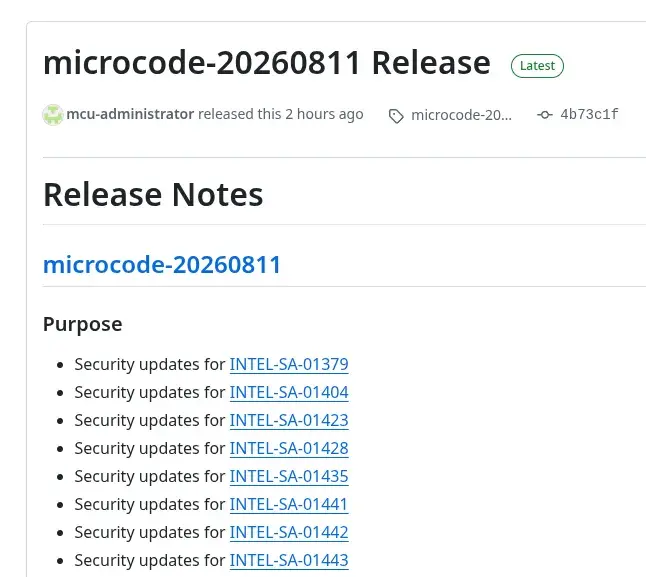
System owners must apply the August 11 patch to prevent privilege escalation
The microcode version 20260811 introduces specific fixes for distinct architectural weaknesses in Intel chips. INTEL-SA-01379 targets Intel TDX and Xeon 6, allowing attackers to escalate privileges within trusted domains. INTEL-SA-01428 creates a similar privilege escalation risk for all Core Ultra and Xeon 6 processors. These vulnerabilities require immediate attention because they compromise the fundamental isolation guarantees of modern computing environments.
Intel also resolved transient execution data forwarding errors in INTEL-SA-01423, which impacts tenth-generation Core processors and newer models. A denial-of-service flaw in INTEL-SA-01441 specifically targets Core Ultra Series 2 and 3 chips. Xeon 6 processors face two additional privilege escalation risks detailed in INTEL-SA-01435 and INTEL-SA-01442. Legacy hardware is not immune, as INTEL-SA-01443 exploits hardware logic race conditions in third-generation Xeon Scalable processors.
This release marks the first appearance of microcode images for the Bartlett Lake and Wildcat Lake platforms. The inclusion of these new identifiers suggests that Intel is preparing these architectures for mass production or imminent market entry. Users with systems based on these upcoming platforms should expect early adoption of this security patch. We looked at the last Intel Core Ultra / Intel Xeon update while tracking these platform developments.
Intel confirmed the release of version 20260811 to address these eight specific security issues. The update ensures that both current-generation and legacy processors maintain their security integrity against known exploits. System builders and IT managers should verify that their BIOS and firmware repositories include this specific microcode version. This patch closes critical gaps in Intel’s hardware security model across its entire product stack.
Discussion
0 comments
Log in to join the thread with a thoughtful take, question, or correction.