
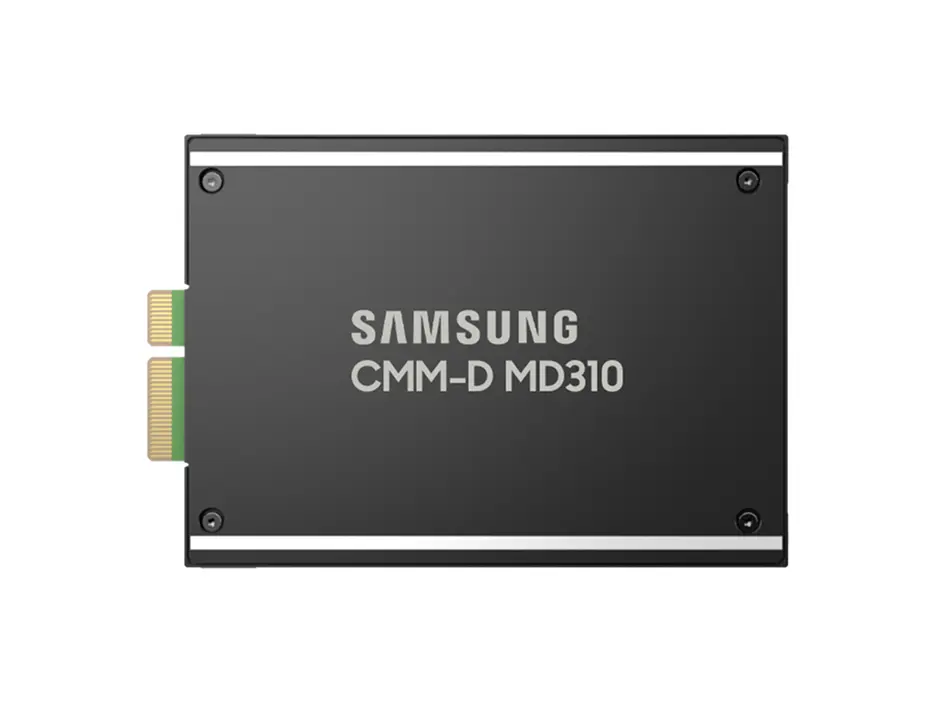
Samsung Electronics introduced the MD310, a new memory module designed to address the growing bandwidth demands of AI and data analysis workloads. This announcement is significant because enterprises running data-intensive tasks often encounter bottlenecks that standard memory architectures cannot resolve efficiently. The MD310 provides a pathway to increased throughput without necessitating a complete server redesign.
New module delivers 72GB/s bandwidth for data-intensive tasks
The MD310 is a DRAM-based CXL memory module that leverages the PCIe 6.0 interface and CXL 3.2 protocol. It utilizes the EDSFF E3.S 2T form factor, which allows for higher density in modern server racks. The module is built on DDR5 technology to ensure compatibility with existing high-speed memory standards.
Specifications
- Protocol: CXL 3.2
- Interface: PCIe 6.0
- Capacity: 256GB
- Speed: 7.2Gbps
- Bandwidth: 72GB/s
Samsung states that the MD310 provides a capacity of 256GB with speeds reaching 7.2Gbps. This configuration delivers an additional 72GB/s of memory bandwidth to the system. The open PCIe and CXL architecture enables dynamic sharing and allocation of this pooled memory across multiple systems.
This dynamic memory pooling capability enables servers to share resources more flexibly than traditional fixed-memory configurations. It supports efficient resource distribution for applications that require large, shared memory spaces. The module targets environments where memory scalability is critical for performance.
We looked at DDR5 Memory Prices Surge 320% as earlier while tracking Samsung electronics launches. The MD310 signifies a shift toward pooled memory architectures that can adapt to fluctuating workload demands. This technology aims to improve efficiency for data-heavy enterprise applications.

Discussion
0 comments
Log in to join the thread with a thoughtful take, question, or correction.