
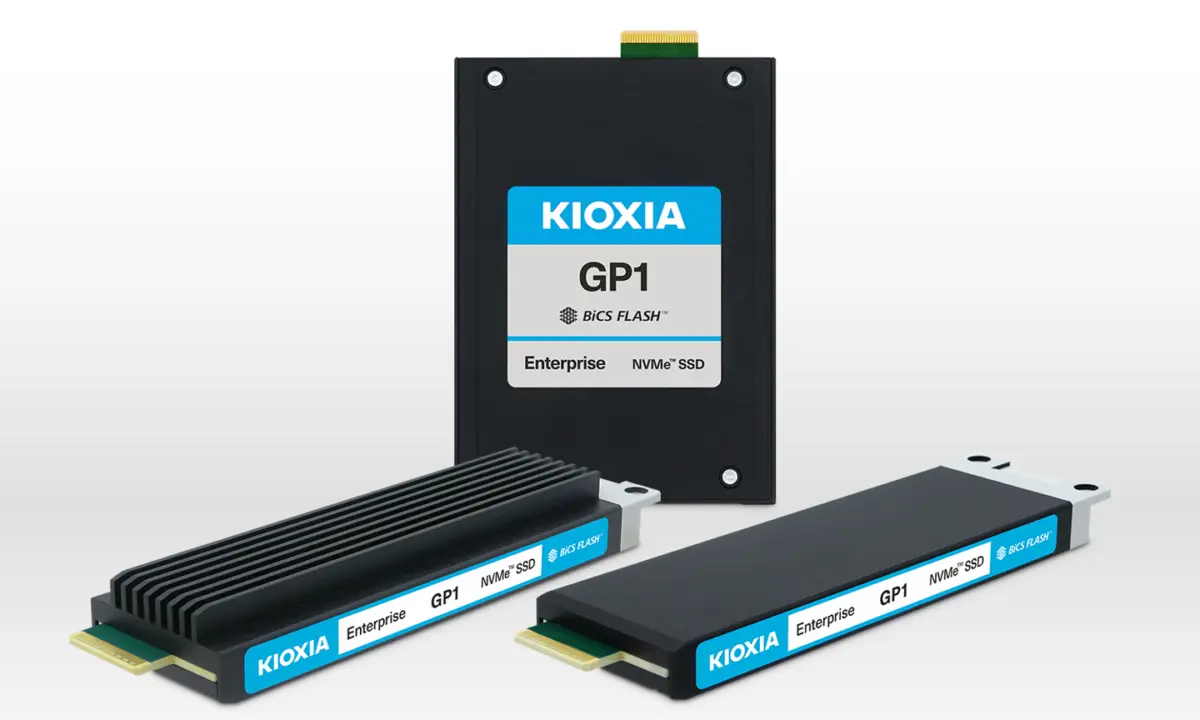
Data centers building large AI clusters face a steep cost wall when expanding GPU memory. KIOXIA addresses this bottleneck with the GP1, a new solid-state drive that lets GPUs access high-speed flash directly. This approach offers a cheaper way to scale memory capacity compared to adding more HBM or DRAM chips to each server node.
New drive uses flash as GPU memory extension
The drive relies on KIOXIA’s XL-FLASH 3D NAND technology to bridge the gap between fast processors and storage. It complies with the latest PCIe Gen6 and NVMe 2.2 standards to ensure low latency during data access. KIOXIA designed the GP1 to support new AI storage architectures that treat flash as an extension of GPU memory rather than just long-term storage.
Specifications
- Interface: PCIe Gen6, NVMe 2.2
- Form Factor: EDSFF E3.S, E1.S
- Random Read Performance: 100M IOPS
- Endurance: 50 DWPD
- Granularity: 512 bytes
KIOXIA offers the GP1 in two EDSFF form factors: E3.S and E1.S. The drive achieves 100 million random read IOPS and supports 512-byte data access granularity. It also provides up to 50 drive writes per day (DWPD) of endurance. These specs allow the drive to handle the intense, random access patterns typical of AI training workloads.
Neville Ichhaporia, KIOXIA’s senior vice president and general manager of the SSD business, stated that the drive lowers the cost per gigabyte compared to expanding onboard HBM or DRAM. He described the GP1 as a breakthrough product that will (spawn) a new, leading AI memory topology. The company plans to begin sample deliveries to customers by the end of 2026.
We looked at Team Group Unveils PCIe Gen6 SSD earlier while tracking Kioxia launches. Both companies are pushing the boundaries of next-generation storage interfaces for AI infrastructure. The KIOXIA GP1 confirms that the industry is actively developing hardware solutions to overcome current memory scaling limits.
Discussion
0 comments
Log in to join the thread with a thoughtful take, question, or correction.