
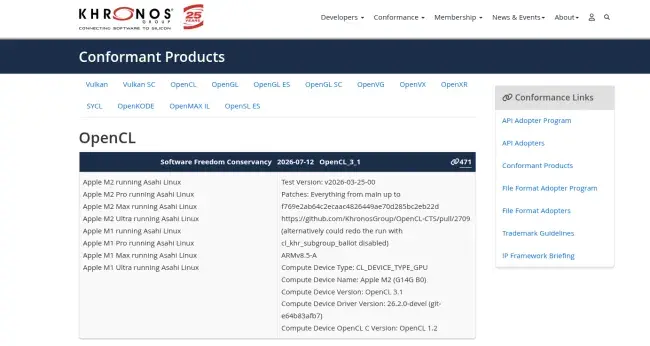
Apple M1 and M2 chips have achieved the first global OpenCL 3.1 certification, marking a significant milestone for open-source computing on Apple Silicon. This achievement matters to developers and power users who rely on Linux for high-performance computing and AI workloads. It proves that community-driven reverse engineering can unlock advanced graphics compute capabilities on hardware Apple officially does not support. The certification validates the technical maturity of the Asahi Linux project.
Community driver enables high-performance computing on Apple Silicon
The certification was achieved using Asahi Linux running on Apple M1 or M2 hardware. The underlying technology powering this support is the Mesa Rusticl driver. Rusticl is a Rust-based OpenCL implementation designed for the Gallium3D driver stack. This stack allows Linux to communicate with the Apple Silicon GPU without official vendor drivers.
OpenCL 3.1 focuses on AI and high-performance computing workloads. The certification confirms that the implementation passes the complete OpenCL 3.1 conformance test suite. This means the driver meets strict industry standards for compatibility and performance. It is not a beta or experimental build but a formally recognized standard.
Karol Herbst from Red Hat confirmed the certification on Mastodon. He stated that as of July 13, Rusticl is the first OpenCL 3.1 conformant implementation. This official recognition adds credibility to the open-source community's efforts. It signals that third-party drivers can now claim full standard compliance on Apple hardware.
This milestone highlights the growing capability of community projects to extend hardware lifecycles. Developers can now target OpenCL 3.1 for cross-platform compute applications on Apple Silicon. The achievement stands as a testament to the Asahi Linux team's reverse engineering work. It remains a community-supported solution rather than an official Apple product.

Discussion
0 comments
Log in to join the thread with a thoughtful take, question, or correction.