
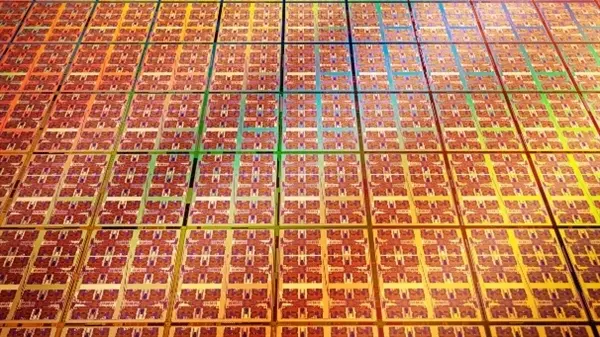
A new TrendForce report maps out the AI CPU roadmaps of eight major vendors, revealing a fierce competition between x86 and ARM architectures. TSMC emerges as the primary foundry for most chips, cementing its role in the industry.
NVIDIA Vera and AMD Zen6 Venice lead the pack
NVIDIA plans to ship its Vera CPU in 2026, using a custom Olympus architecture with up to 88 cores and 176 threads on a 3nm process. AMD’s Zen6 Venice will push to 256 cores and 512 threads on a 2nm node. Intel’s Xeon 6+ will feature up to 288 cores on its in-house 18A process.
AI CPU Spec Comparison
| Spec | NVIDIA Vera | AMD Zen6 Venice | Intel Xeon 6+ | Ampere |
|---|---|---|---|---|
| Cores/Threads | 88 cores, 176 threads | 256 cores, 512 threads | up to 288 cores | 256 cores |
| Process Node | 3nm | 2nm | 18A | 3nm |
| Architecture | Custom Olympus | Zen6 | Xeon 6+ | Custom |
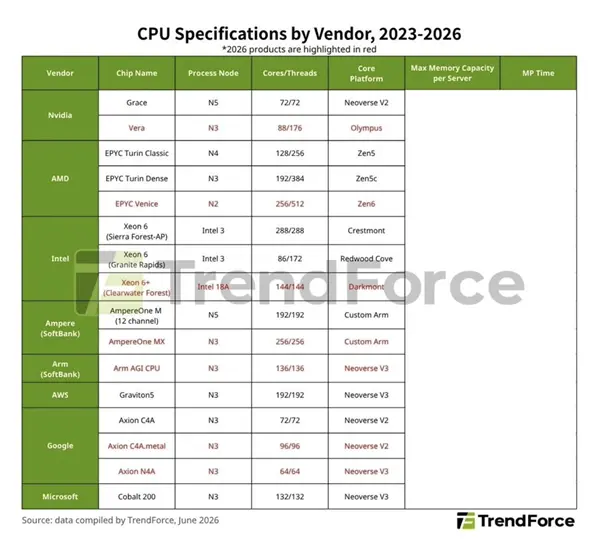
Ampere offers up to 256 cores on TSMC 3nm. ARM’s AGI CPU packs 136 cores based on the Neoverse V3 architecture. AWS, Google, and Microsoft are developing ARM-based CPUs with 64 to 192 cores on 3nm.
TrendForce notes that ARM CPUs can now compete with x86 in both single-core and multi-core performance. The report also cautions that Intel’s Xeon 6+ core count may be inaccurate in the chart.
All other vendors rely on TSMC for 5nm to 3nm production, according to the report. The first shipments of these AI CPUs are expected in 2026. We looked at Nvidia and Microsoft Use AI to earlier while tracking Nvidia, amd, intel, ampere, arm, aws, google, microsoft launches.
Discussion
0 comments
Log in to join the thread with a thoughtful take, question, or correction.