

Researchers at the National Institute of Standards and Technology (NIST) have demonstrated a metal 3D printing method that uses elliptical laser paths to stir molten metal. This approach enables alloy mixing during the print process, allowing for on-demand creation of new materials. The technique requires no new hardware; existing machines can implement it via a software update.

Technique verified at Argonne National Laboratory
The method was developed at NIST and verified at Argonne National Laboratory. Researchers fused RHEA-19 high-entropy alloy with titanium alloy to create a new alloy. In-situ X-ray diffraction at the Advanced Photon Source captured atomic structure during solidification in under a second.
The Advanced Photon Source produces X-ray beams roughly 500 billion times brighter than a dental scanner, according to NIST. This capability allowed researchers to observe the alloy formation process in real time. The technique could enable on-demand alloy blending and graded composition parts for jet turbine blades.
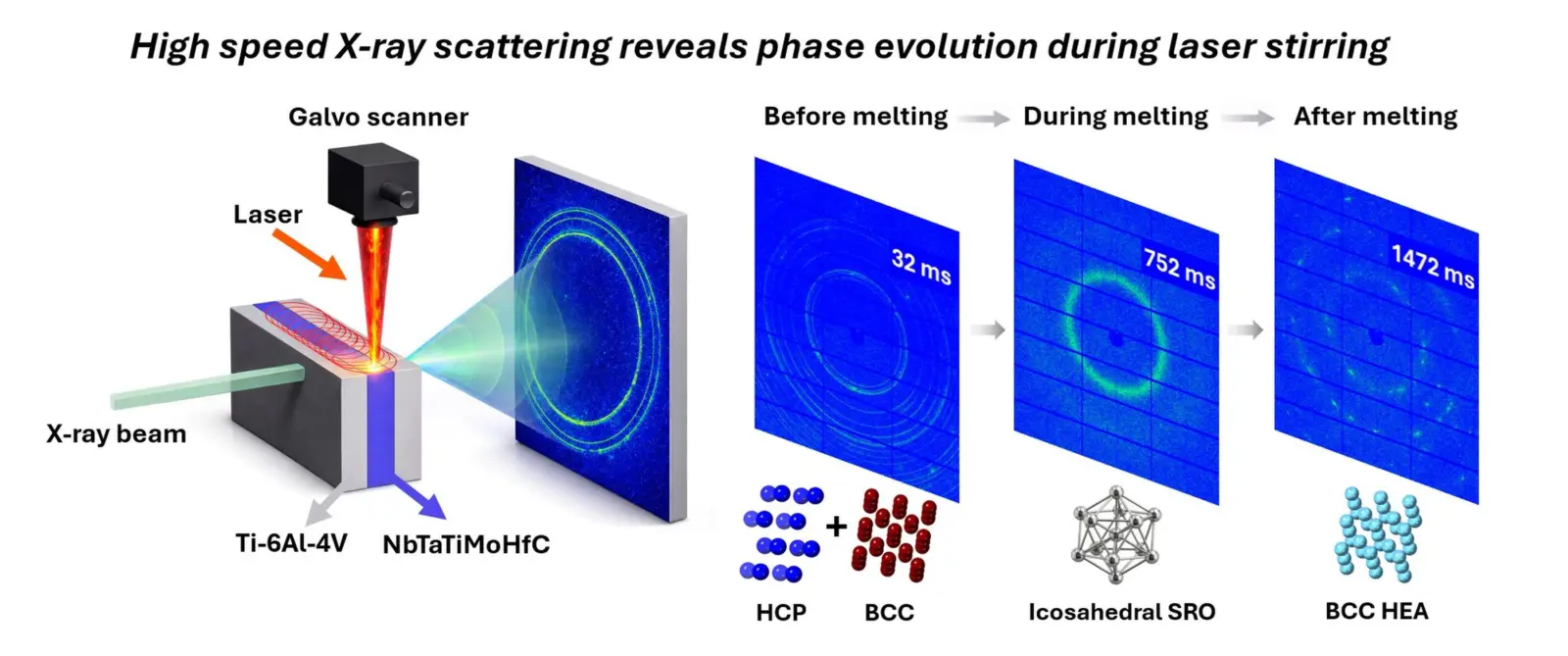
Ho Yeung, a NIST researcher, stated that commercial 3D printer software cannot make these patterns. The team developed custom software to control the elliptical laser paths. Potential applications include creating parts with varying material properties in a single print.
The technique blends alloys that resist mixing without new hardware, according to NIST. This means machines already in service could adopt the method through a software update. The research was published in the journal Additive Manufacturing.


Discussion
0 comments
Log in to join the thread with a thoughtful take, question, or correction.