
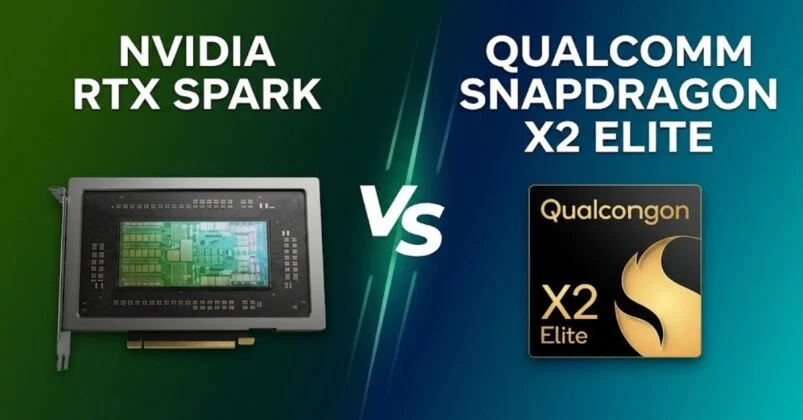
Qualcomm's next-generation Snapdragon X2 Elite and Nvidia's RTX Spark are set to compete in the Windows on Arm laptop market. Both chips promise significant performance gains, but they target different priorities.
Snapdragon X2 Elite packs 18 Oryon cores.
The Snapdragon X2 Elite Extreme packs 18 Oryon cores: 12 prime cores clocked up to 5 GHz and 6 performance cores at up to 3.6 GHz. It includes 53 MB of cache and an 80 TOPS NPU. The RTX Spark is based on the GB10 Grace Blackwell Superchip, featuring 20 CPU cores and a 6144-core Blackwell GPU with up to 128 GB of unified memory.
Spec comparison
| Spec | Snapdragon X2 Elite Extreme | Nvidia RTX Spark |
|---|---|---|
| CPU cores | 18 (12 prime + 6 performance) | 20 |
| Max CPU clock | 5 GHz (prime cores) | N/A |
| NPU performance | 80 TOPS | >100 TOPS |
| Memory support | Up to 48GB LPDDR5x | Up to 128GB unified |
| GPU cores | N/A | 6144 CUDA cores |
In benchmark results shared by Qualcomm, the Snapdragon X2 Elite Extreme scored 1964 in Cinebench 2024 and 23693 in Geekbench 6.3 multi-core. Those numbers match the Apple M4 Pro. Nvidia claims the RTX Spark delivers over 1 PFLOPS FP4 AI compute and more than 100 TOPS for on-device AI.
RTX Spark focuses on AI and GPU compute.
The RTX Spark supports DLSS 4.5 and the CUDA ecosystem, giving it an edge in GPU-accelerated workloads and AI software compatibility. The Snapdragon X2 lacks an equivalent GPU upscaling solution and a comparable AI software platform.
Laptops with the Snapdragon X2 Elite will arrive in the first half of 2026. RTX Spark laptops are expected in fall 2026, starting at about $1,800.
The Snapdragon X2 Elite Extreme shows roughly 39% higher single-core and 50% higher multi-core performance compared to the previous X Elite. The RTX Spark enters a different segment, focusing on AI and GPU compute rather than raw CPU throughput.
Discussion
0 comments
Log in to join the thread with a thoughtful take, question, or correction.