
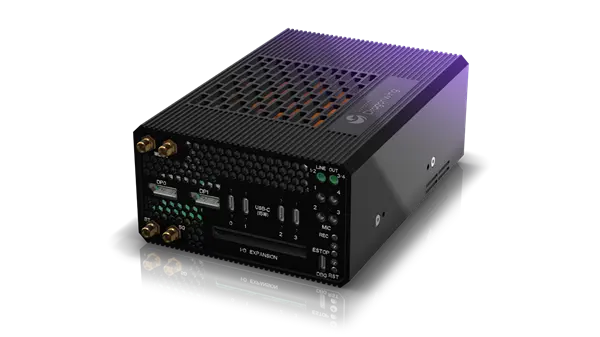
Qualcomm has introduced the Snapdragon IQ10 Robot Reference Design (RRD), a new platform aimed at industrial, autonomous mobile robot (AMR), and humanoid robotics applications. The announcement highlights a focus on integrating high-performance AI compute with robust sensor support and deterministic control interfaces for real-time operations.
The platform integrates an 18-core Oryon CPU with up to 700 TOPS of AI compute power for edge robotics tasks
The RRD is built around an 18-core Qualcomm Oryon CPU paired with a multi-core neural processing unit (NPU) and a graphics processing unit (GPU). This architecture is designed to deliver up to 700 TOPS of AI compute performance, enabling edge perception, planning, and inference tasks without relying on external accelerators.
- AI Compute Performance: Up to 700 TOPS
- CPU Cores: 18-core Qualcomm Oryon CPU
- Camera Support: Native support for up to 12 GMSL2 cameras
- Operating Temperature Range: -40°C to 70°C
- Power Input: 12V/24V
For sensor integration, the platform natively supports up to 12 GMSL2 camera connections. It also accommodates LiDAR, time-of-flight (ToF), and inertial measurement unit (IMU) sensors. The system is engineered to operate reliably within an environmental temperature range of -40°C to 70°C.
Power delivery for the RRD accepts both 12V and 24V inputs. To ensure deterministic control, the design includes high-speed interfaces such as PCIe, Time-Sensitive Networking (TSN), USB, CAN, Ethernet, EtherCAT, and CAN-FD. These connections facilitate precise real-time I/O for critical robotic functions.
The RRD will make its official debut at Computex 2026 in Taipei. Global general availability is scheduled for September 2026. Qualcomm has opened a registration process to notify interested parties when the platform becomes available.
This release follows earlier industry trends toward integrated AI robotics solutions, positioning the Snapdragon IQ10 as a comprehensive reference design that combines hardware and software capabilities. The inclusion of ROS2 tools, AI runtimes, and MLOps/DevOps support aims to streamline development for manufacturers.
Discussion
0 comments
Log in to join the thread with a thoughtful take, question, or correction.