
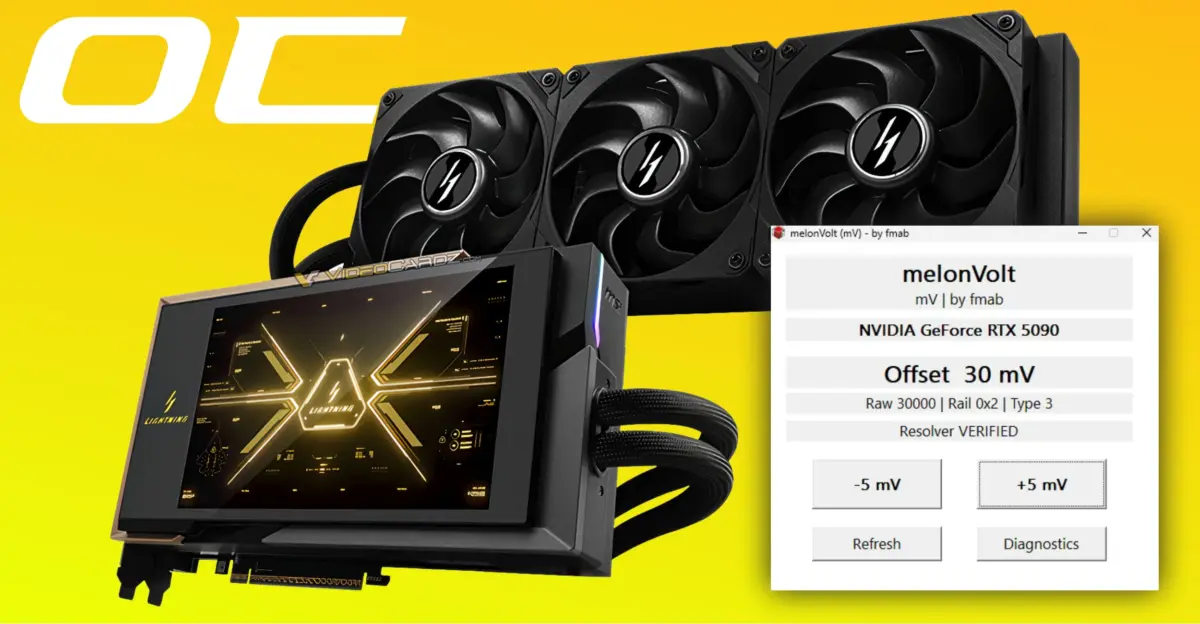
We can now push the GeForce RTX 5090's crossbar clock higher with a new utility, which matters because even small frequency bumps can translate to measurable frame rate gains in demanding games. The melonVolt tool, developed by Overclock.net user Fmab., gives users direct control over the MSVDD voltage offset, a setting that previously locked many enthusiasts out of fine-tuning their hardware. This release shifts the responsibility for stability from the driver to the user, requiring careful monitoring to avoid system crashes.
New utility allows direct MSVDD voltage control for higher crossbar frequencies
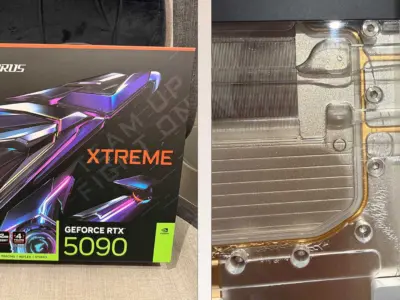
The software targets the NVIDIA GeForce RTX 5090 and its specific partner variants, including models from Gigabyte, ASUS, and MSI. Users can adjust the MSVDD voltage in precise 5 mV steps, allowing for granular tuning that standard driver interfaces do not provide. The tool is compatible with a wide range of cards, including the GIGABYTE AORUS Xtreme WB, MSI RTX 5090 Lightning, and various ASUS ROG Astral and MATRIX models. This broad compatibility means that owners of different high-end cards can all access the same tuning capabilities.
Specifications
- melonVolt MSVDD tuning range: 5 mV steps
- Gigabyte AORUS Xtreme WB XBAR gain: +142 MHz (2625 to 2767 MHz)
- ASUS ROG Astral 5090 + Deltamate XBAR gain: +137 MHz (2647 to 2784 MHz)
- Default MSVDD offset: -50 mV
- Safe MSVDD voltage: 1.075 V
NVIDIA set a default MSVDD offset of -50 mV in driver 572.60 to prevent black screen stability issues that plagued earlier releases. The melonVolt utility allows users to increase this offset, which can unlock higher XBAR clocks. Users report clock gains ranging from 90 to 142 MHz by raising the voltage from the default setting. For example, the Gigabyte AORUS Xtreme WB saw a gain of +142 MHz, moving from 2625 MHz to 2767 MHz. The ASUS ROG Astral 5090 achieved a +137 MHz gain, reaching 2784 MHz from a base of 2647 MHz.
Running the MSVDD offset above 1.075 V is considered unsafe and may cause black screens on some cards. NVIDIA warns that running the voltage above the default continuously may cause black screens on some cards, highlighting the risk involved in aggressive tuning. The long-term stability of increased offsets varies by card quality, BIOS version, and cooling solution. Some users have already confirmed that setting the offset too high may result in stability issues returning. The melonVolt developer notes that additional headroom can raise the GPU's crossbar frequency, although the tool comes with a clear warning to use it at your own risk.
We looked at the last GeForce RTX 5090 update earlier while tracking NVIDIA launches, and several of the same balance and stability themes came up. This new tool offers more control but requires users to navigate the same stability risks that prompted the original driver changes. The confirmed facts are that melonVolt exists, it unlocks higher clocks, and it carries a significant stability risk if misused. Users should proceed with caution and monitor their system closely when adjusting voltage offsets.

Discussion
0 comments
Log in to join the thread with a thoughtful take, question, or correction.