
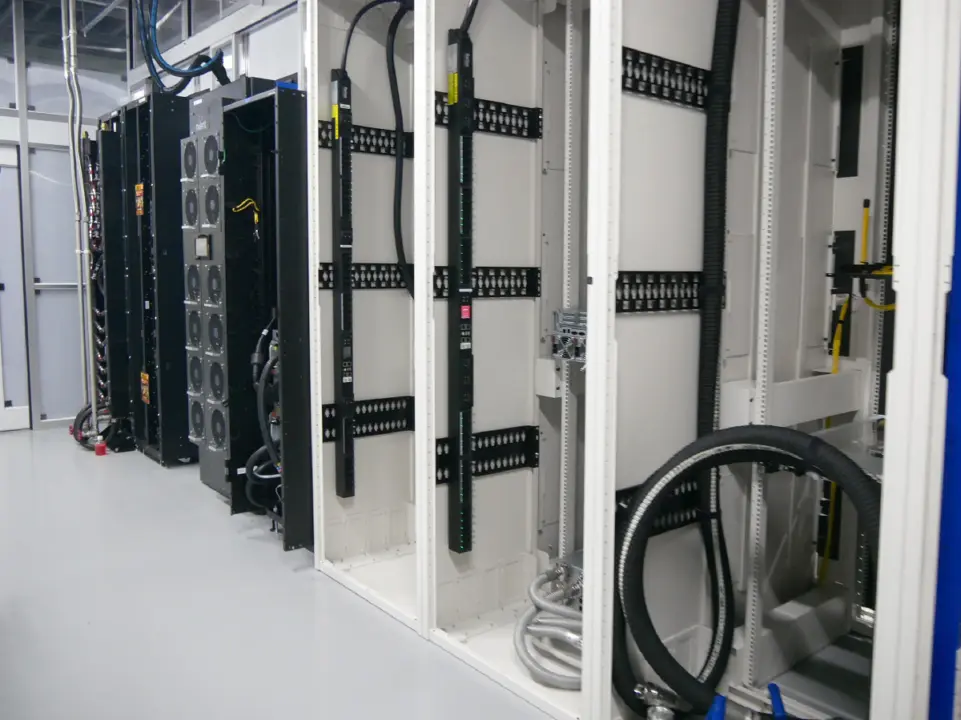
Lenovo Japan has opened a new validation facility called the Neptune Lab in Inzai, Chiba Prefecture. The lab sits inside MC Digital Realty's DRIL data center and focuses on liquid cooling solutions for AI-era workloads. It aims to address rising power consumption and heat density challenges in modern data centers.
New validation facility demonstrates liquid cooling efficiency for AI workloads
The facility integrates Lenovo's sixth-generation Neptune liquid cooling system with Nidek cooling distribution units (CDUs). A ThinkSystem SC750 V4 Neptune server runs on Intel Xeon 6900 series processors within a 13U rack. The setup uses distilled water at temperatures up to 45 degrees Celsius and eliminates the need for glycol.
- Cooling Technology: 6th Generation Lenovo Neptune liquid cooling (warm water up to 45°C, distilled water only, no glycol)
- Power Consumption Reduction: Up to 40% reduction in power consumption for data center cooling
- Noise Level: Library-level quietness achieved
- Deployment Form Factor: Fits in less than a 19-inch rack; scalable from exascale supercomputers down to single-rack units
- Testbed Configuration: ThinkSystem SC750 V4 Neptune with Intel Xeon 6900 series, connected to Nidek CDU in a 13U rack, 48V power supply
Lenovo Neptune reduces data center cooling power consumption by up to 40 percent while maintaining library-level quietness. The system scales from exascale supercomputers down to single-rack deployments under 19 inches wide. The system employs high-density copper water loops, aluminum base cold plates, and robust EPDM rubber seals to ensure operational reliability.
A promotional TruScale lease offer is available in Japan for a three-node SR630 V4 configuration with Intel Xeon 6530P processors. The five-year lease costs approximately 1,258,000 JPY per month, reflecting a 35 percent discount from standard pricing. This arrangement allows customers to test the hardware before committing to long-term deployment.
Lenovo Japan President Taro Hiyama stated that AI investment in Japan is projected to double or triple by 2027 compared to 2023 levels. The company designed Neptune Lab to support both training and inference workloads while providing practical benefits to Japanese enterprises. Partners including Intel, Nidek, and MC Digital Realty contribute to the validation environment.
Data centers currently account for three percent of global electricity usage, with Japan's demand expected to triple by 2030 as more facilities come online. Cooling represents roughly 40 percent of total data center energy consumption. Neptune Lab enables customers to validate leak sensors, hybrid cloud integration, and operational performance under real conditions.
The facility supports proof-of-concept testing for AI inference and training workloads alongside hybrid cloud configurations. Customers can evaluate cooling efficiency, power draw, and system reliability before full deployment. Lenovo positions the lab as a platform for discussing Japan-specific data center challenges including cost, regulation, and operational practices.
Discussion
0 comments
Log in to join the thread with a thoughtful take, question, or correction.