
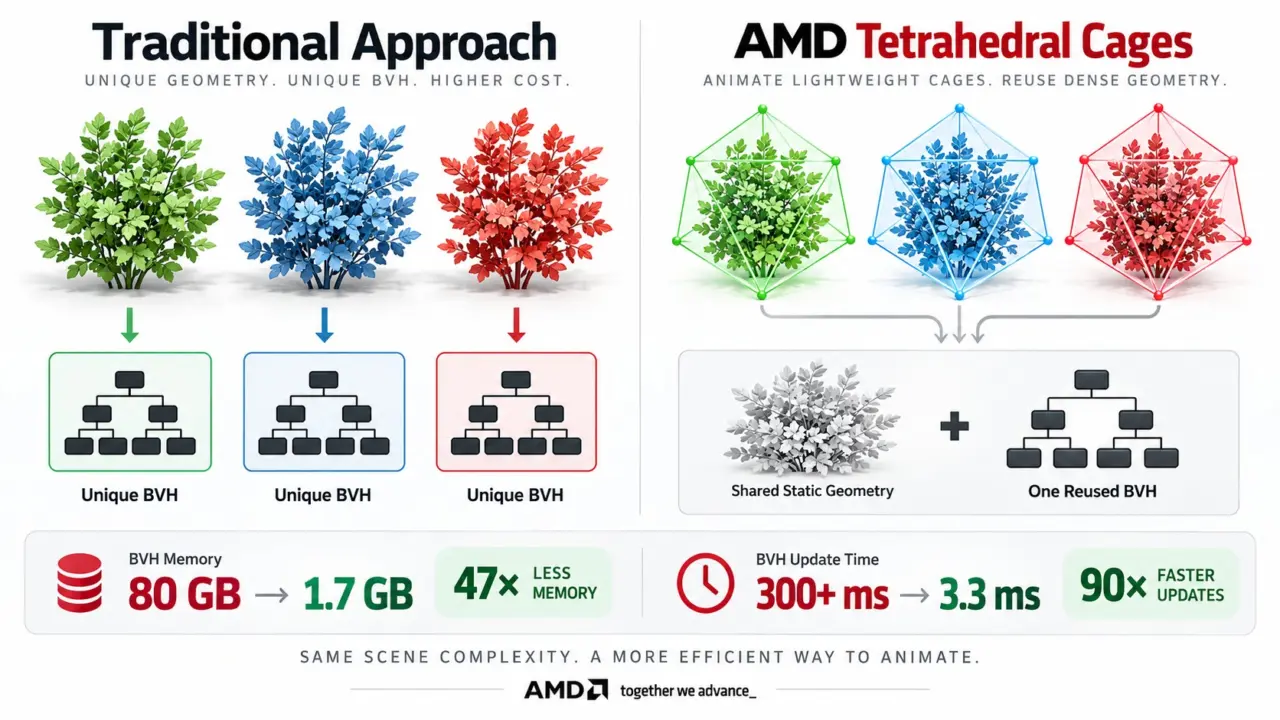
AMD has demonstrated a new ray tracing technique that drastically cuts the memory and processing power needed to render complex animated scenes. This matters because real-time ray tracing in dense environments, like crowded cities or thick forests, has traditionally required massive amounts of video memory and computing time. The company’s research shows that developers can now handle hundreds of millions of moving objects without the usual performance penalties.
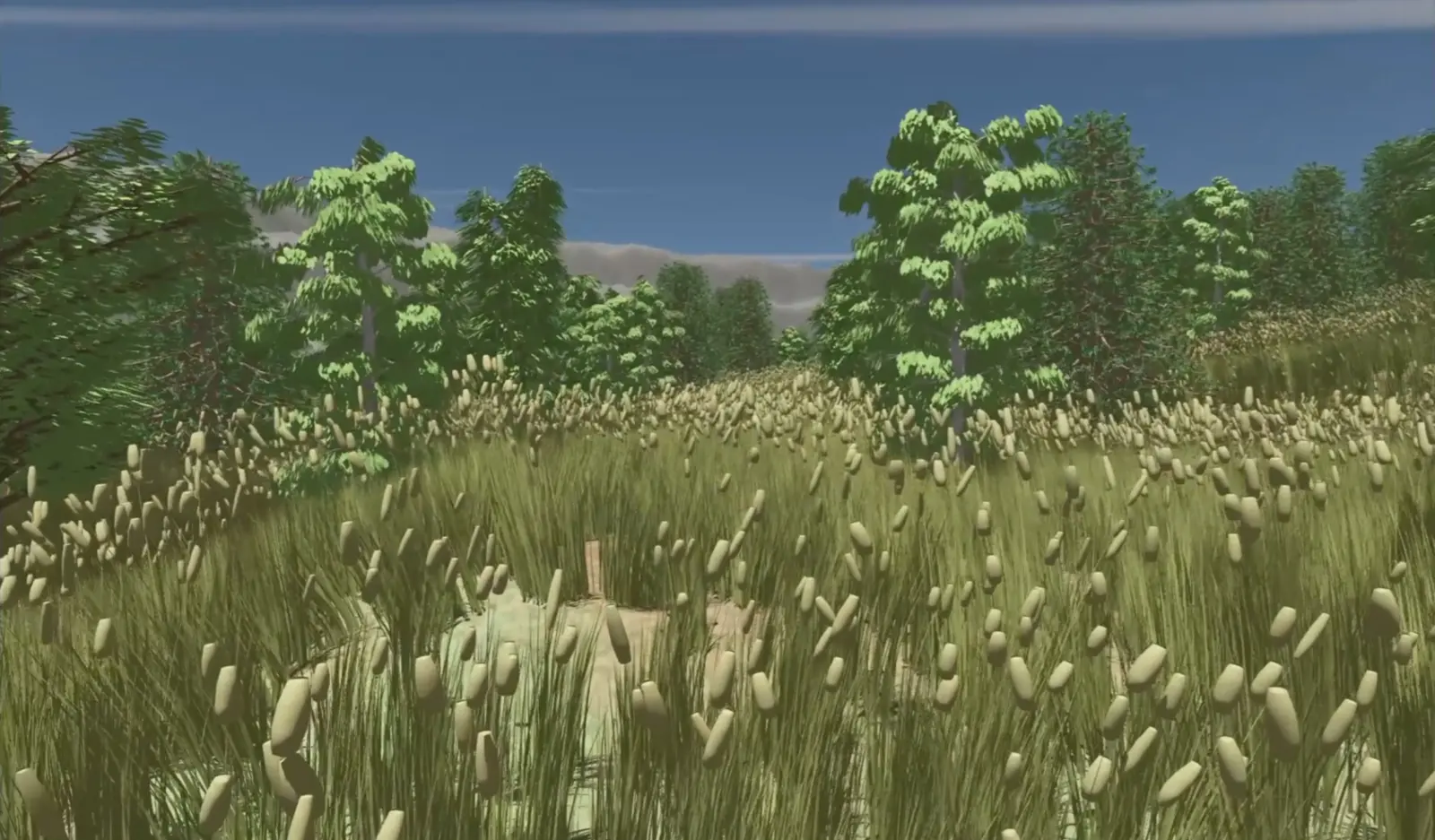
New technique reduces memory overhead for complex animated environments
The demonstration ran on the Radeon RX 9070 XT GPU and utilized a method called the tetrahedral cage technique. This approach replaces the standard Bounding Volume Hierarchy (BVH) acceleration structure with a more efficient mesh-based system. By organizing triangles into tetrahedrons, the system reduces the overhead typically associated with tracking moving geometry in real-time rendering.
The technical results show a 47-fold reduction in BVH memory usage, dropping from approximately 80 GB to just 1.7 GB. BVH update time also fell by more than 90 times, shrinking from over 300 ms to roughly 3.3 ms per frame. These metrics allowed the GPU to ray trace around 500 million animated triangles while maintaining a steady frame rate of over 60 FPS at 1080p resolution.
AMD presented this research at the High-Performance Graphics 2026 conference, where it won the third-place Wolfgang Straßer Best Paper Award. The technique is particularly useful for scenes with dense foliage or large crowds, though it does sacrifice some fine-grained control over individual vertex animations. This trade-off allows for significant performance gains in specific types of complex environments.
This technology remains a research demonstration and is not yet available in shipping games or drivers. AMD GPUOpen highlighted the breakthrough as a way to significantly reduce computational costs for future ray tracing workloads. The company continues to explore these methods to improve real-time rendering efficiency for developers.
Our team notes that while this is not a consumer feature today, it points to a clear direction for future GPU architecture. The reduction in memory overhead could eventually allow for more complex scenes in upcoming titles. We will track whether AMD integrates these techniques into its software stack in the coming years.

Discussion
0 comments
Log in to join the thread with a thoughtful take, question, or correction.