
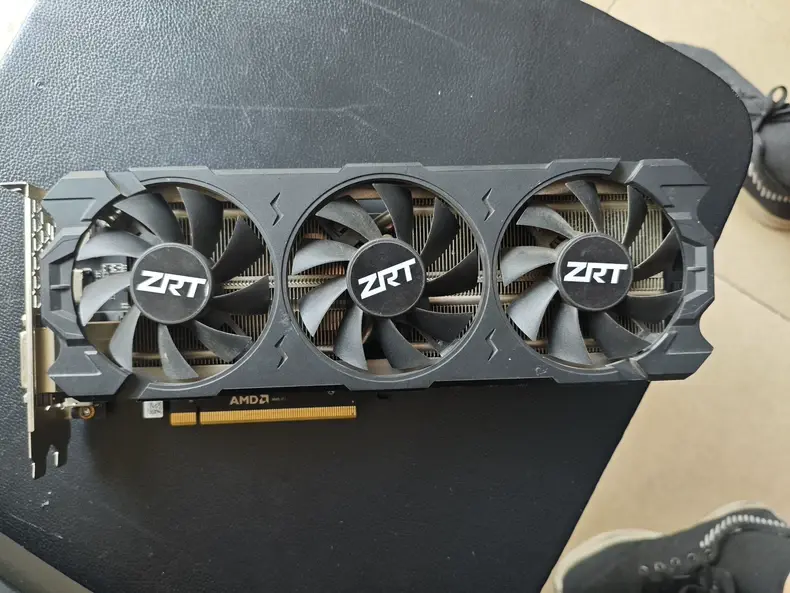
The AMD R9 Fury, an 11-year-old graphics card, is gaining attention for its extreme memory width specifications and its current availability in the second-hand market. Buyers looking for budget hardware are discovering that this older card offers a unique technical profile that contrasts sharply with modern flagship GPUs. This retrospective look highlights how a 2015 design still holds specific architectural advantages despite its age.
11-year-old graphics card offers massive bandwidth for budget gamers
The R9 Fury utilizes the Fiji core architecture built on AMD's Graphics Core Next (GCN) design. It was the first consumer-grade graphics card to feature High Bandwidth Memory (HBM). This memory technology uses 3D-stacking to place memory directly on the GPU package, which saves space and allows for a massive data path. The card features a 4096-bit memory width, which is significantly wider than the 512-bit width found on the NVIDIA RTX 5090.
Specifications
- Memory Width: 4096-bit
- Memory Type: HBM (High Bandwidth Memory)
- Memory Bandwidth: 512GB/s
- Core Architecture: Fiji / GCN
- TDP: 275W
Technical specifications for the R9 Fury include a memory bandwidth of 512GB/s and a Thermal Design Power (TDP) of 275W. To manage this heat, the card employs a cooling solution with three fans, five 8mm heatpipes, and a vapor chamber base. In synthetic benchmarks, the card achieves a score of 4917 in 3DMark Time Spy. This performance is approximately 12% faster than the GTX 980 and 13% faster than the RX 580.
Driver support for the R9 Fury ended in June 2022, which may cause compatibility warnings when installing modern game drivers. Despite this, the card can still run demanding titles like Cyberpunk 2077 at 1080p High settings. Users can achieve over 100 FPS in this title by enabling FSR performance mode and frame generation technologies. The card is currently available in the second-hand market for approximately 300 CNY (around $44.61).
The R9 Fury remains a viable option for budget gamers who prioritize raw memory bandwidth and are willing to use upscaling technologies. Its unique HBM architecture offers a different performance characteristic compared to standard GDDR6 cards found in newer GPUs. The card's ability to maintain high frame rates in modern titles through FSR demonstrates the enduring value of its core design.
Discussion
0 comments
Log in to join the thread with a thoughtful take, question, or correction.