
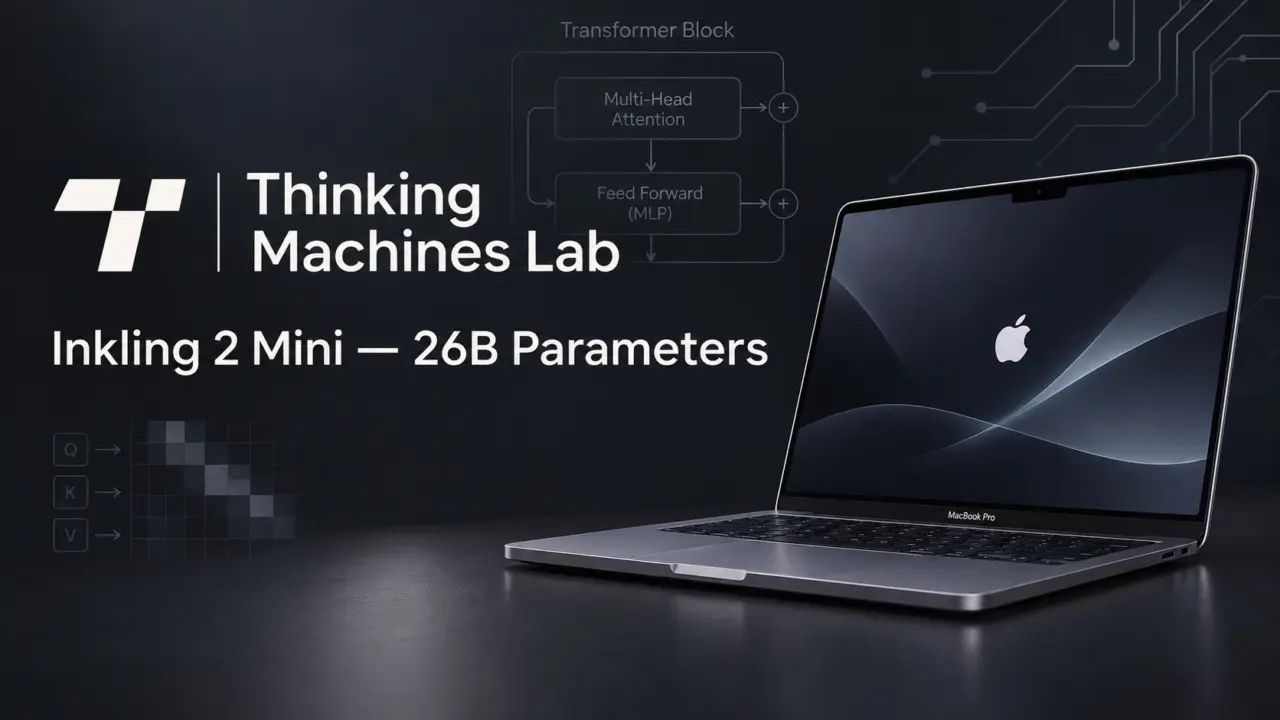
On November 20, Thinking Machines launched Inkling 2 Mini. With this launch, Thinking Machines now brings a powerful LLM with deep reasoning capabilities to PCs. It is important because now, developers can have a large language model which can run on the memory of a regular macbook.

Developers can now process large codebases locally without cloud costs
This means developers no longer have to use pricey cloud solutions for powerful AI tools. People who regularly have to process huge volumes of code or data now have a powerful engine that can run on their own machines.
At the heart of Inkling 2 Mini lies a highly optimized 24-layer Mixture of Experts (MoE) transformer. This architecture was custom-built by Thinking Machines to achieve peak efficiency. The model boasts a total of 26.4 billion parameters but uses only 3.4 billion active parameters during inference, resulting in much lighter compute requirements. Thinking Machines introduced an innovative loop for the middle 12 layers, which are run three times to boost reasoning ability without increasing the parameter count.
With its lean memory usage of around 20GB, Inkling 2 Mini can be run on MacBooks with 32GB unified memory. It offers a context window of up to one million tokens, making it ideal for processing long documents or codebases in one go. Most of the model’s weights are stored in 4-bit NVFP4 precision, but the last 4 layers use 8-bit MXFP8 precision to ensure accuracy where it counts.
Inkling 2 Mini is now live on Hugging Face and Ollama under Apache 2.0 license, ensuring global accessibility. As per Thinking Machines, Inkling 2 Mini scored 48.2% in DeepSWE v1.1 and 77.9% in SWE-bench Pro v2 Hard. The tests were run on NVIDIA GB300 Grace Blackwell Ultra machines. However, the company warns that results may differ depending on the testing setup.
The Artificial Analysis Intelligence Index score of 20.1 for Inkling 2 Mini positions it as a strong contender among open-weight models. With Inkling 2 Mini, Thinking Machines offers a valuable alternative to proprietary APIs for teams focused on data privacy and on-device processing. Developers can instantly start leveraging this model in their work with standard open source tools.



Running 26 billion parameters on 32GB of unified memory sounds impressive on paper. The key metric here is whether that 20GB footprint holds up when you add the OS and other development tools to the mix.