

MiniMax introduced M3.1 Flash on October 19, 2026. This model is a game-changer in the economics of deploying large language models. MiniMax asserts that M3.1 Flash provides frontier-level intelligence with significantly reduced compute costs compared to typical Western labs' requirements.
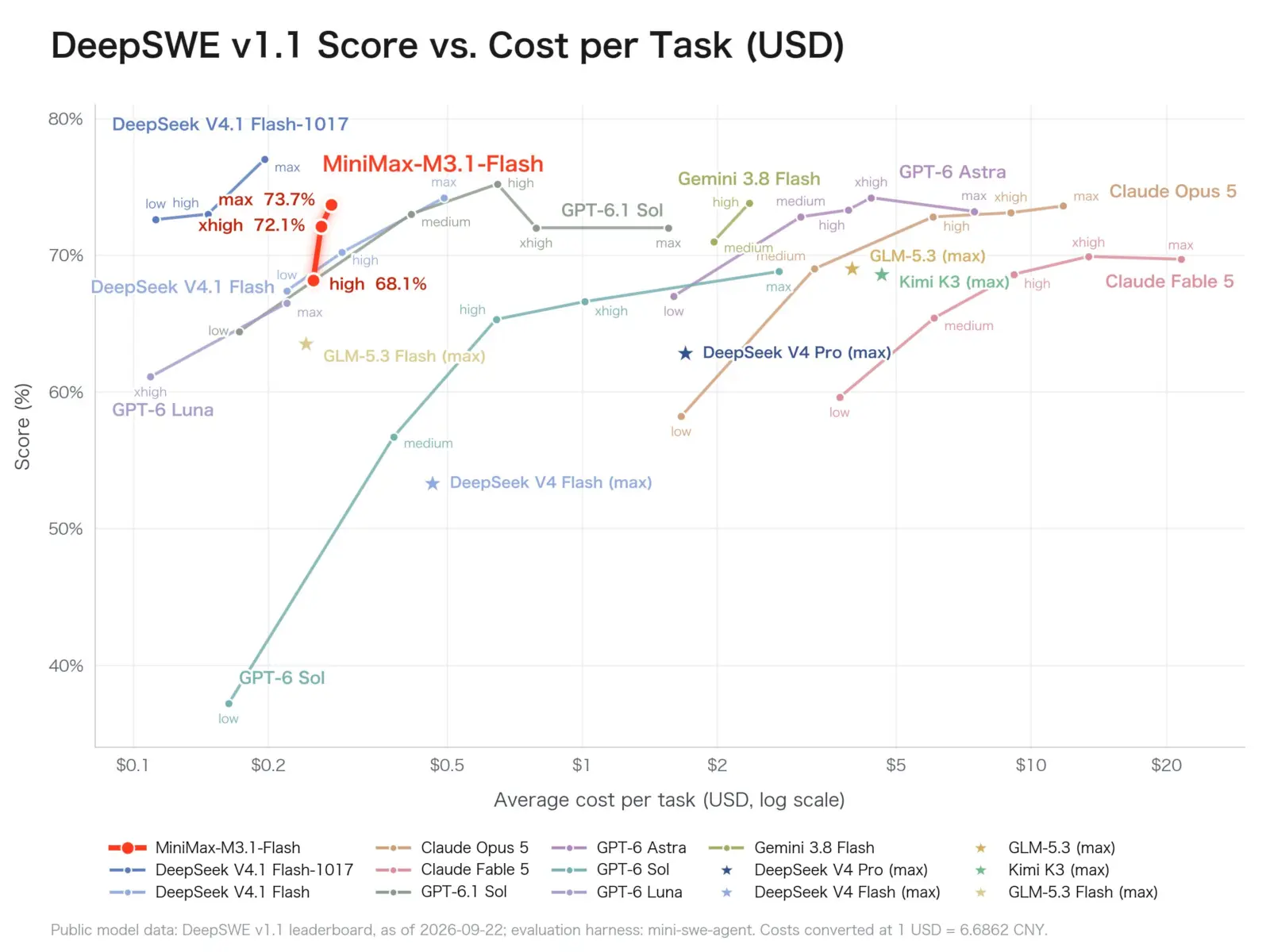
MiniMax M3.1 Flash architecture represents a sparse mixture-of-experts model
For developers working on agentic workflows or high-throughput text services, this opens up the potential of LLMs for substantially lower costs. This is significant as it democratizes access to such capabilities for teams that were previously unable to afford the GPU resources to tackle complex tasks.
M3.1 Flash architecture represents a sparse mixture-of-experts model, featuring a total of 428 billion parameters. However, only 23 billion parameters are active in any given inference step. This approach enables handling enormous datasets without needing extensive hardware resources. MiniMax emphasizes that M3.1 Flash is a strong competitor to more costly options by prioritizing extreme efficiency over sheer parameter size.
MiniMax specifies that M3.1 Flash operates with a mere 70,000 H100-equivalent GPUs. This is a significant departure from OpenAI's reported usage of 3.7 million H100-equivalent GPUs. MiniMax achieves this efficiency through their proprietary MiniMax Sparse Attention, which cuts down the compute per token to one-twentieth of the cost of conventional attention mechanisms. Their custom GPU kernels further optimize performance, providing a 9x speed boost for initial prompt reading and 15x speed for text generation at long context lengths.
M3.1 Flash is priced according to its efficient operational profile. Input tokens cost $0.15 per million tokens, and output tokens are $0.60 per million tokens. MiniMax asserts that these costs lead to a 70 percent cost reduction for agentic tasks relative to earlier models.
MiniMax also states that M3.1 Flash enables nearly 3x faster online inference and can generate more than 200 tokens per second in everyday use. These numbers indicate that M3.1 Flash is highly optimized for real-time scenarios where cost and latency are key concerns.
This release underscores a significant trend where different approaches to model scaling are emerging. While Western rivals are pushing for massive compute clusters, Chinese AI labs like MiniMax and DeepSeek are reaching frontier capabilities with sub-100,000 H100-equivalent resources. Analysts observe that while distillation is a factor, it isn't the sole reason behind the performance parity.
Instead, architectural innovations seem to play a more dominant role. MiniMax's M3.1 Flash exemplifies the power of efficient design in contesting the stronghold of resource-intensive models.
Discussion
0 comments
Log in to join the thread with a thoughtful take, question, or correction.