
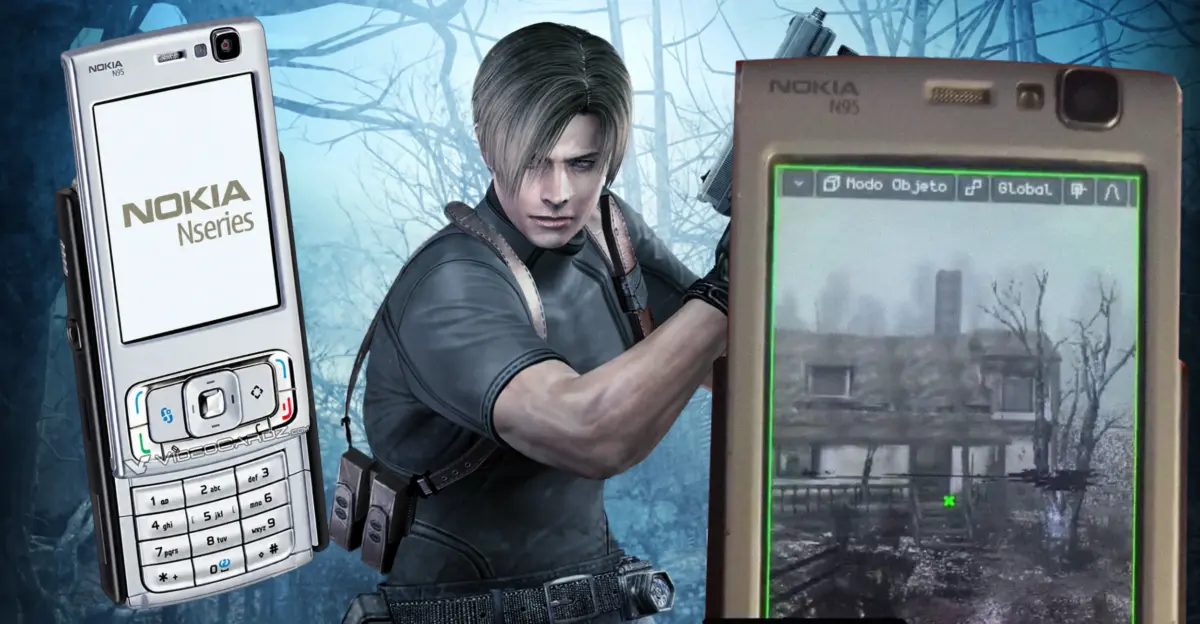
A developer has successfully run Resident Evil 4 on a 2007 Nokia N95 smartphone, proving that legacy mobile hardware can handle complex 3D game engines. This technical feat illustrates the capabilities of legacy mobile hardware that has since become outdated. The port relies on an open-source software engine to translate modern game assets for older processors.
Legacy Nokia N95 hardware handles Resident Evil 4 cutscene
The project centers on the Nokia N95, which features a Texas Instruments OMAP 2420 system-on-chip running at 332 MHz and a PowerVR MBX GPU. Developer Dante D. Leoncini utilized the Whisk3D software engine to render the game, pulling assets directly from the Nintendo GameCube version of Resident Evil 4. This specific hardware configuration includes OpenGL ES 1.1 support, which the engine leverages for graphics processing.
The primary technical hurdle involves character skinning for deformable 3D meshes that contain more than 10,000 vertices. Leoncini noted that the current test faces performance bottlenecks in this CPU-side calculation rather than in the rendering process itself. Real-time processing of these complex meshes places a significant load on the ARM11 CPU's processing capacity.
Despite the current bottlenecks, Leoncini estimates that the test could run at 30 FPS or higher if the team switches to lower-poly assets. The estimated performance increase indicates that the device could achieve playable frame rates using lower-polygon models. The test underscores the constraints of the PowerVR MBX graphics processor when rendering high-detail geometry.
We covered the last Resident Evil 4 update, where several of the same balance and stability themes came up during the development process. The confirmed facts include the successful execution of the game engine on the N95 and the identification of the skinning bottleneck as the main constraint. The project serves as a technical proof-of-concept rather than a commercially available product.
Discussion
0 comments
Log in to join the thread with a thoughtful take, question, or correction.