
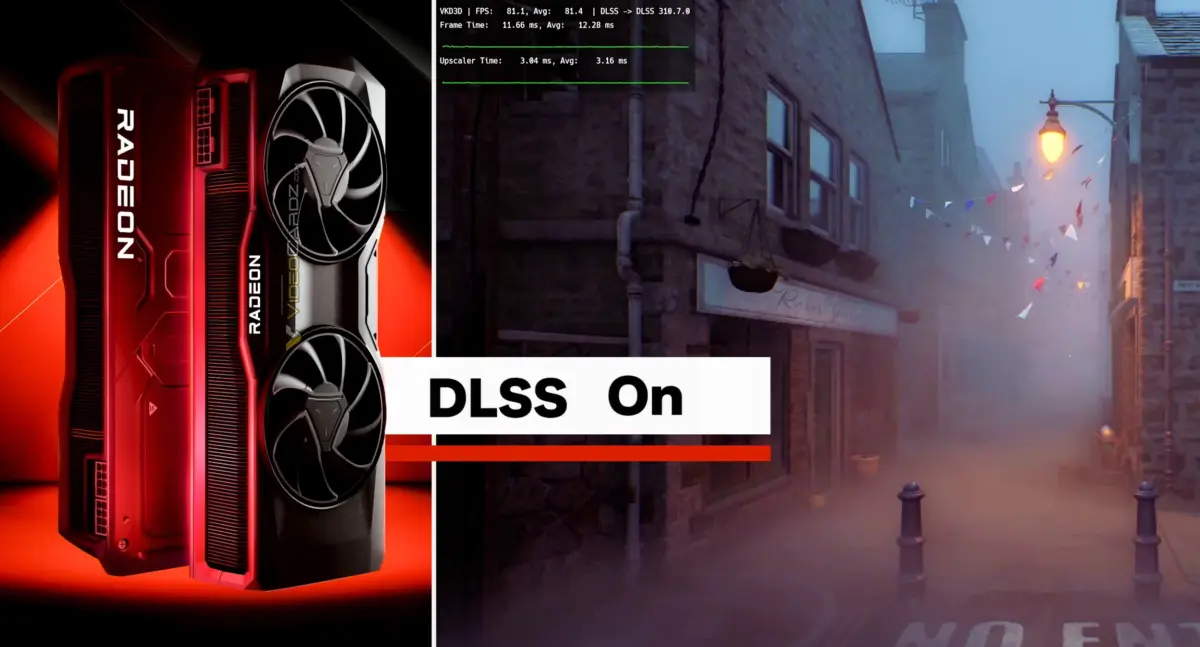
PC gamers using AMD Radeon RX 7000 series cards on Linux can now access NVIDIA's Deep Learning Super Sampling technology through a community-driven compatibility layer. This development matters because it offers an alternative upscaling method for users who prefer AMD hardware but want to leverage NVIDIA's specific rendering features in supported titles. The project, known as d4r, bridges the gap between two competing graphics ecosystems without requiring official driver support.
Community tool enables NVIDIA upscaling on AMD RDNA3 hardware under Linux
The d4r tool enables official NVIDIA DLSS to run on AMD RDNA3 GPUs under Linux and Proton environments. It targets the Navi 32 architecture, which powers the Radeon RX 7700 XT, RX 7800 XT, RX 7700, and Radeon PRO W7700. Modder countervolts engineered the solution to intercept DirectX 12 calls and redirect them through a custom DLL that translates the workload for AMD hardware.
The technical pipeline starts with the game sending DLSS inputs to OptiScaler, which passes them to d4r_nvngx.dll. This shim forwards the requests to NVIDIA's official NGX core and nvngx_dlss.dll, maintaining the standard CUDA execution path. The system then uses nvcuda.dll as a Wine bridge to connect to ZLUDA, which translates the PTX code into native RDNA3 kernels. This architecture allows the GPU to execute DLSS 4 and 4.5 network layers directly on AMD silicon.
Performance benchmarks on the RX 7700 XT at 1440p show DLSS 3 achieving 72.4 FPS in Quality mode, while DLSS 4 reaches 69.4 FPS in the same setting. DLSS 4.5 performs significantly slower at 51.5 FPS in Quality mode due to its higher computational cost of approximately 7.5 ms per frame. DLSS 4 has a fixed cost of around 2.8 ms, making it more efficient for heavy upscaling modes like Ultra Performance, where it hits 94.5 FPS compared to 88.9 FPS for DLSS 3. AMD's own FSR 4 remains faster than this DLSS implementation across all tested modes.
The current release explicitly excludes support for DLSS 5 and provides limited functionality for Navi 31 and Navi 33 GPUs. Cards based on these older architectures can run DLSS 3 at full speed, but DLSS 4 and 4.5 performance is degraded because native kernels for those chips are not included. Users attempting to run DLSS 4 transformer models without the specific kernel overrides will encounter invalid output that the system discards. The project represents a technical proof of concept for cross-vendor compatibility rather than a polished consumer product.


Discussion
0 comments
Log in to join the thread with a thoughtful take, question, or correction.