
Video editors and gamers can now offload frame interpolation tasks to NVIDIA graphics cards instead of relying solely on CPU processing. This change matters because hardware acceleration significantly reduces the computational load, making high-frame-rate video conversion faster and less taxing on system resources. The update arrives in the main development branch of FFmpeg, the widely used open-source multimedia framework.
Open source tool uses GPU optical flow units to double video frame rates
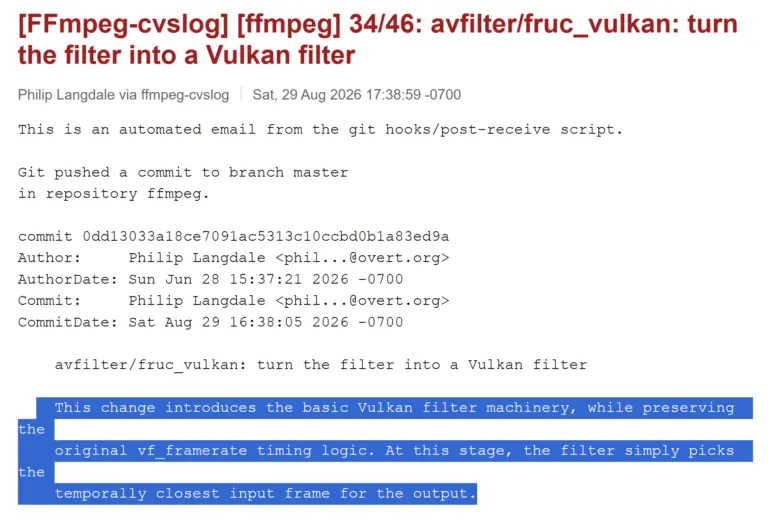
The core addition is the Frame Rate Up-Conversion (FRUC) filter, which leverages NVIDIA's dedicated optical flow hardware units. This hardware component estimates motion between frames to generate intermediate images, allowing the software to double video frame rates. The feature converts standard 24fps film content to 48fps or 30fps video to 60fps without requiring proprietary software development kits.
- Feature: FRUC (Frame Rate Up-Conversion) hardware-accelerated interpolation filter
- Supported GPUs: RTX 30, RTX 40, RTX 50 series
- Unsupported GPUs: RTX 20 series (Turing architecture)
- API Interface: Vulkan SDK 5.0
- Functionality: Converts 24fps to 48fps or 30fps to 60fps
Support for this feature is limited to specific NVIDIA GPU architectures. The implementation currently supports RTX 30, RTX 40, and RTX 50 series graphics cards. Users with RTX 20 series cards based on the Turing architecture cannot use this function. The exclusion stems from incompatibility with the required Vulkan SDK 5.0 interface, which the new filter depends on for operation.
Other recent NVIDIA patches for FFmpeg, including Virtual Super Resolution and TrueHDR, were reverted in this update. Only the FRUC filter remains in the main development branch. Users must compile the development version of FFmpeg to access the feature, as no official stable release includes it yet. We looked at the last FFmpeg update, several of the same balance and stability themes came up.
This update provides a concrete path for users with supported NVIDIA hardware to accelerate video frame interpolation. The feature is available immediately for those willing to build from the development source code. It marks a shift toward hardware-accelerated media processing in open-source tools.
Discussion
0 comments
Log in to join the thread with a thoughtful take, question, or correction.