
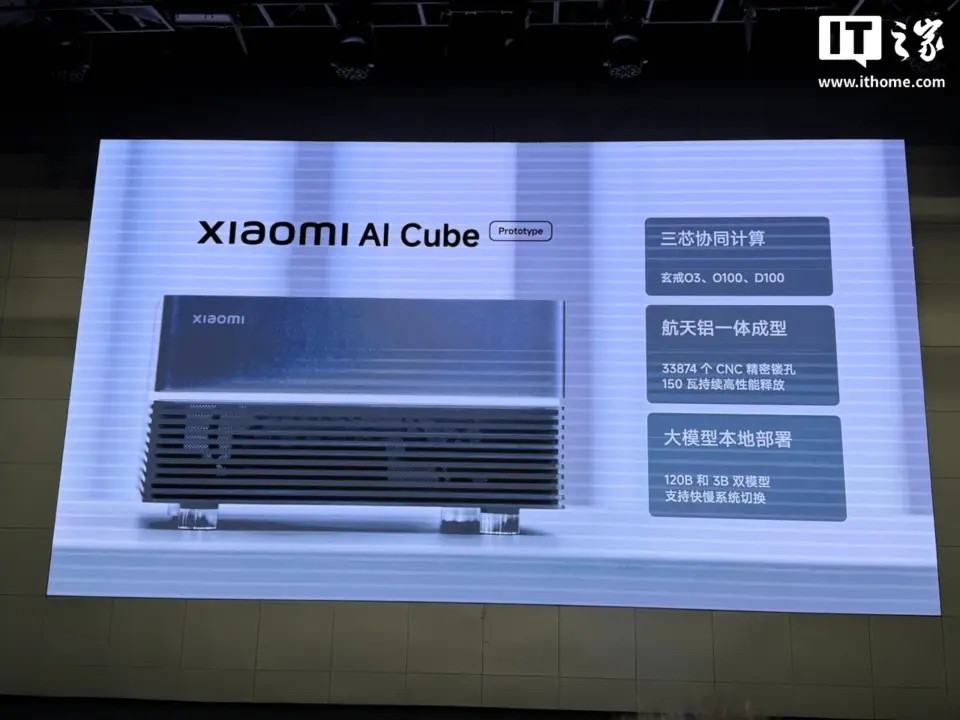
Xiaomi has introduced the AI Cube Prototype, a compact desktop system designed to run large language models locally. This release matters because it demonstrates that consumer-grade hardware can now handle significant AI workloads without relying on cloud servers. Users interested in private AI deployment or local model testing have a new physical platform to evaluate.
Compact desktop system demonstrates local large language model deployment capabilities
The system relies on a three-chip architecture to manage its computational tasks. The core AI SoC is the Xuanjie O3, which combines a 10-core all-big-core CPU with a 16-core G2-Ultra NX GPU. This processor also includes a dedicated NPU capable of 200 TOPS of low-power performance.
Specifications
- CPU: 10-core all-big-core Xuanjie O3
- GPU: 16-core G2-Ultra NX
- NPU: 200 TOPS low-power
- AI Accelerator: Xuanjie O100 (1.22TB/s bandwidth)
- Chassis: Aerospace aluminum with 33,874 CNC holes
To support the heavy lifting of AI inference, the prototype integrates two additional specialized chips. The Xuanjie O100 AI accelerator uses 6nm 3D wafer-level packaging to deliver 1.22TB/s of memory bandwidth. The Xuanjie D100 high-compute chip utilizes a 3nm process and supports up to 160GB of memory, providing the necessary capacity for large models.
The hardware is housed in an aerospace aluminum chassis featuring 33,874 CNC precision holes for thermal management. This design allows the system to sustain 150W of performance continuously. The device officially supports the local deployment of 120B and 3B parameter large language models.
Xiaomi has not yet disclosed the release date or the final price for the AI Cube Prototype. The company stated that these details remain unannounced at this time. The prototype currently serves as a demonstration of the company's internal silicon capabilities rather than a ready-to-buy consumer product.



Discussion
0 comments
Log in to join the thread with a thoughtful take, question, or correction.