
Intel Foundry Services is accelerating its timeline to capture a larger share of the semiconductor manufacturing market, a shift that could reshape competition for major tech buyers seeking alternative chip production partners. The company raised $20 billion through stock issuance to fund this expansion, signaling a serious commitment to building out its fabrication capabilities. This financial injection supports aggressive goals to grow foundry revenue nearly 40 times to reach $40 billion by 2030, according to projections from Bank of America Research.
Bank of America estimates Intel will capture 10% of the global foundry market
The core of this strategy relies on specific process nodes that are currently moving through critical production phases. Intel reports that yields for its 18A process node are entering the ramp-up phase for actual products. Simultaneously, the advanced 18A-P process node is undergoing risk production this year. These steps are essential for Intel to compete directly with established leaders in the advanced packaging and semiconductor foundry sectors.
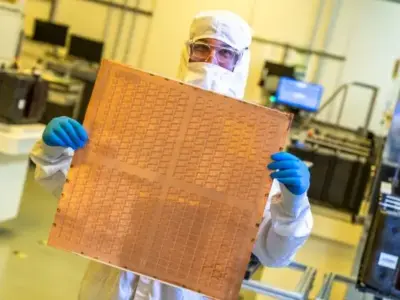
Intel plans to mass produce its 14A process node in 2028, which is one year ahead of its previous schedule. This accelerated timeline positions Intel to challenge TSMC's A14 node in the competitive landscape of chip manufacturing. The company also highlights its EMIB packaging technology, claiming it is cheaper than TSMC's CoWoS solution. Bank of America estimates that Intel aims to capture 10% of the $380 billion chip foundry market and 30% of the $20 billion advanced packaging market.
Future revenue projections suggest that Intel could secure orders from major technology firms including Microsoft, Meta, Amazon, and Apple for its EMIB packaging services. These expectations remain unconfirmed as the company works to validate its manufacturing capabilities with external partners. We looked at the last Intel Foundry Services update earlier while tracking these developments, noting that balance and stability themes have consistently appeared in previous reports. Intel's ability to execute on these timelines will determine whether it can translate these financial and technical milestones into sustained market share growth.
Discussion
0 comments
Log in to join the thread with a thoughtful take, question, or correction.