
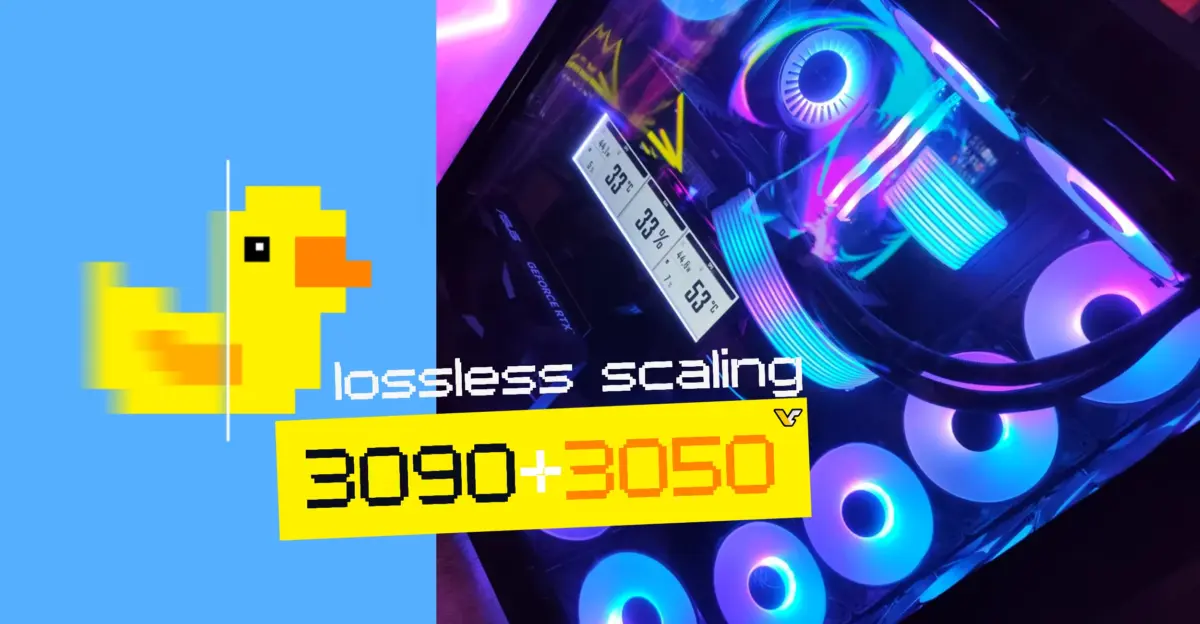
Gamers with older NVIDIA graphics cards can now push frame rates higher by splitting the workload across two different GPUs. This setup allows users to bypass the lack of official frame generation support on RTX 30 series hardware. It matters because it offers a path to 4K 144 FPS without requiring a new flagship card.
User pairs RTX 3090 rendering with RTX 3050 frame generation to bypass RTX 30 series limitations
The configuration pairs an RTX 3090 for rendering with an RTX 3050 6GB dedicated to frame generation. The primary card handles the heavy lifting of creating native game frames. The secondary card then steps in to generate the intermediate frames needed to smooth out the output.
- Primary GPU (Rendering): GeForce RTX 3090
- Secondary GPU (Frame Generation): GeForce RTX 3050 6GB
- Motherboard: ASUS ProArt X870E-Creator WiFi
- Display: 42-inch LG C4 OLED
- Target Resolution/FPS: 4K 144 FPS
The system runs on an ASUS ProArt X870E-Creator WiFi motherboard with both GPUs connected via PCIe 4.0 x8. The display connects directly to the RTX 3050 to avoid latency from returning processed frames to the main card. This direct connection ensures the generated frames reach the screen efficiently.
The build uses Lossless Scaling software to manage the frame generation process. The user locked the native frame rate to 71 FPS on the RTX 3090. The RTX 3050 then generated enough intermediate frames to reach 144 FPS at 4K HDR. The display used was a 42-inch LG C4 OLED television.
The secondary RTX 3050 was purchased used for 80 EUR (around $91.04). This low-cost addition enables a significant performance boost for the primary GPU. The specific games tested were not disclosed in the report. The exact flow-scale setting used ranged between 60 and 70 percent.
This workaround addresses a gap in NVIDIA's software support for the RTX 30 series. It demonstrates that frame generation can function effectively across separate graphics cards. The setup provides a practical solution for users wanting higher frame rates on older hardware.


Discussion
0 comments
Log in to join the thread with a thoughtful take, question, or correction.