
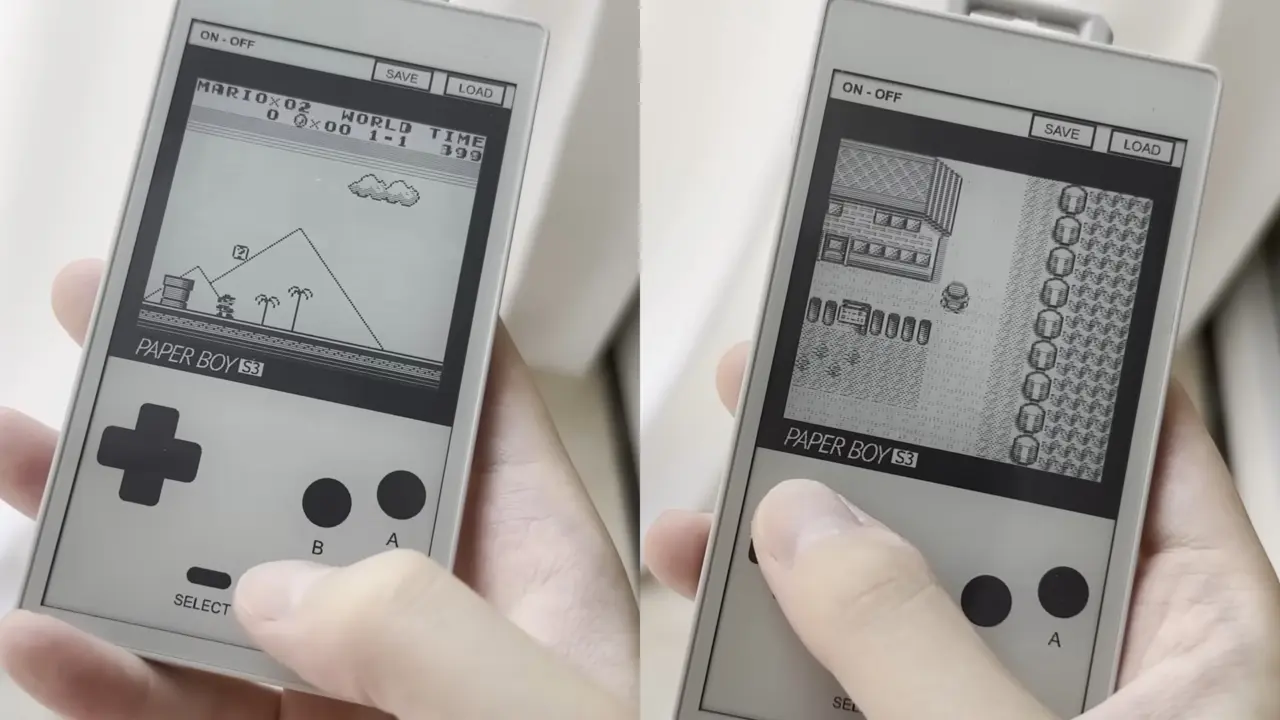
Retro gaming enthusiasts have a new, albeit impractical, way to play classic titles on modern hardware. Designer Wenting Zhang transformed the discontinued M5Stack PaperS3 development kit into a functional Game Boy emulator. This project demonstrates that low-cost microcontrollers can handle retro emulation, but it comes with significant performance trade-offs. The device offers a glimpse into what is possible when developers push limited hardware beyond its intended design.
Designer repurposes discontinued dev kit for retro gaming
The core of this handheld lies in the ESP32-S3 microcontroller, which M5Stack originally designed for IoT applications. Zhang repurposed this dual-core chip to run the emulator, forcing both cores to operate at 100 percent capacity. The system drives a 960×540 E-Ink display, a screen resolution far higher than the original Game Boy’s 160×144 pixels. This massive resolution increase allows for advanced visual techniques that were impossible on the original 1989 hardware.
- Display Resolution: 960×540
- Microcontroller: ESP32-S3
- Display Type: E-Ink
- Refresh Rate: 60Hz
- Emulator Target: Game Boy
To mimic the original Game Boy’s four-shade grayscale palette, the emulator uses dithering across the high-resolution screen. This technique spreads the limited color information across multiple pixels to create the illusion of intermediate shades. The device runs at a 60Hz refresh rate, which is unusually fast for an E-Ink display typically limited to single-digit updates per second. This high refresh rate ensures smooth gameplay for titles like Tetris, Zelda, and Touhou, though it places immense strain on the processor.
Audio output relies on a mono piezo buzzer that attempts to simulate polyphonic sounds, resulting in a quality described as janky compared to original hardware. The device supports Bluetooth LE controllers, allowing players to use external input devices for a more comfortable experience. However, the constant 100 percent CPU utilization suggests that battery life will be poor, as the chip cannot enter low-power states. The PaperS3 hardware is no longer in production, making this project a proof-of-concept rather than a viable commercial product.
This project highlights the creative potential of repurposing obsolete development kits for niche gaming applications. While the emulation experience is technically impressive, the hardware constraints limit its practicality for daily use. The high power consumption and inferior audio quality prevent it from competing with dedicated retro handhelds. It remains a fascinating demonstration of what developers can achieve with the ESP32-S3 platform.

Discussion
0 comments
Log in to join the thread with a thoughtful take, question, or correction.