
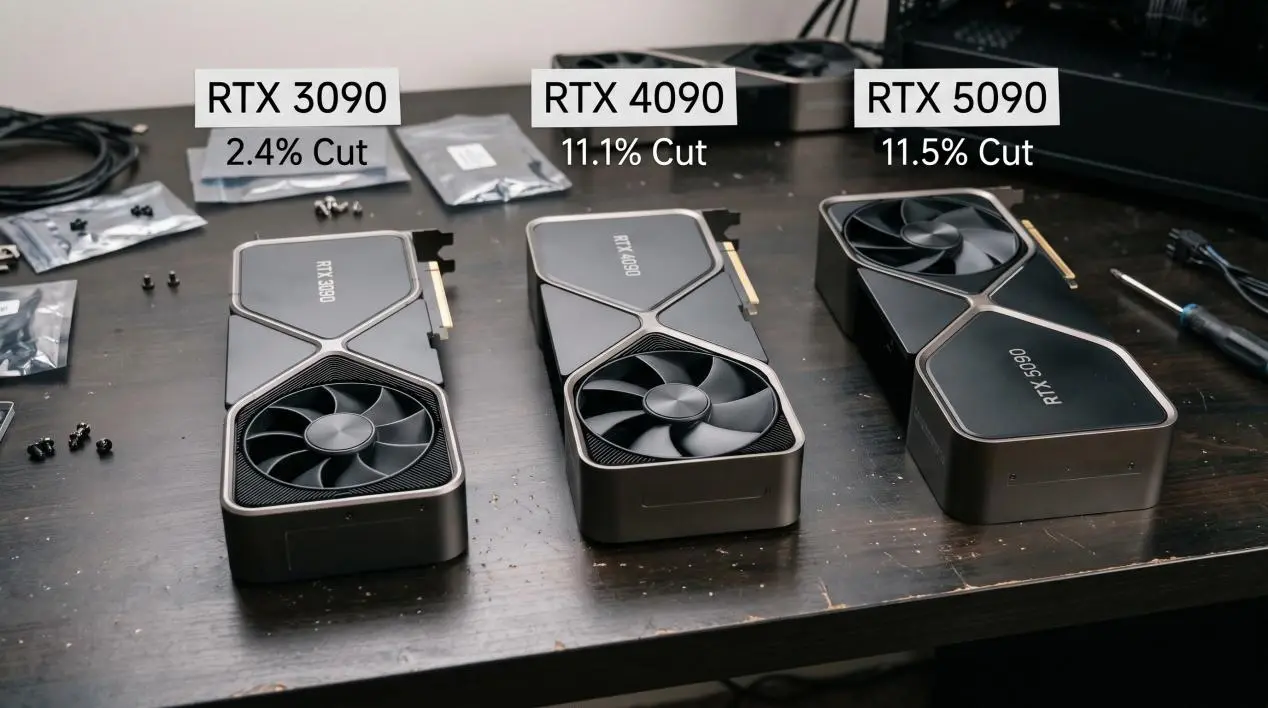
Nvidia is altering its silicon binning approach for the RTX 5090. They are disabling a much greater proportion of cores on the silicon than previous generations. For buyers this has an implication because we are probably going to see more heavily binned (lower quality) silicon for high end gaming cards. This should have some influence on the theoretical performance limit of the flagship gpu vs the pro version.

Flagship gaming card uses heavily binned silicon compared to professional variant
For the RTX 5090 we are seeing the GB202 chip used with 192 physical Streaming Multiprocessors (SM). Nvidia is only activating 170 of these SM on the gaming version. We have 22 SM disabled.
Spec comparison
| Spec | RTX 5090 | RTX PRO 6000 | RTX 4090 | RTX 3090 |
|---|---|---|---|---|
| SM Count Enabled | 170 | 188 | 128 | 82 |
| Total Physical SMs | 192 | 192 | 144 | 84 |
| Disable Rate | 11.5% | 2.1% | 11.1% | 2.4% |
| Chip Name | GB202 | GB202 | AD102 | GA102 |
This gives us a 11.5% disable rate for the flagship consumer card. On the pro version of the RTX PRO 6000 which has the same GB202 silicon we have 188 SM activated. So only 4 SM are disabled.
If we look at the history of the approach to silicon defects in the Nvidia line up we can see a clear difference in strategy. On the previous gen RTX 4090 which had the AD102 chip, we have 128 SM disabled out of 144. Giving us a 11.1% disable rate.
For the RTX 3090 which had the GA102 chip we only had 2 SM disabled out of 84. So we had a much lower 2.4% disable rate. So for the RTX 5090 we are now seeing a more similar disable rate to the RTX 4090 vs the high quality (lower yield) RTX 3090.
For the mid range cards with the RTX 50 series we see different disable strategies further reinforcing the change. For RTX 5060 we have 16.7% SM disabled (36). For the RTX 5050 we are using the entire chip GB207 and have 0 disabled.
This shows how Nvidia is saving nearly perfect silicon for pro/entry level. Now they are accepting a higher defect rate (which was used for lower tier cards in the past) for gaming.
During our monitoring of Nvidia launches we had a report come through for a recent problem of PNY refusing to warranty an RTX 5070 that had blue screens. Even after passing stress tests PNY would not honor the warranty. This report was titled "PNY refuses warranty for RTX 5070". Now looking at our binning numbers we can see this quality control may be affecting different areas of the new gpu's.
Comments (0)