
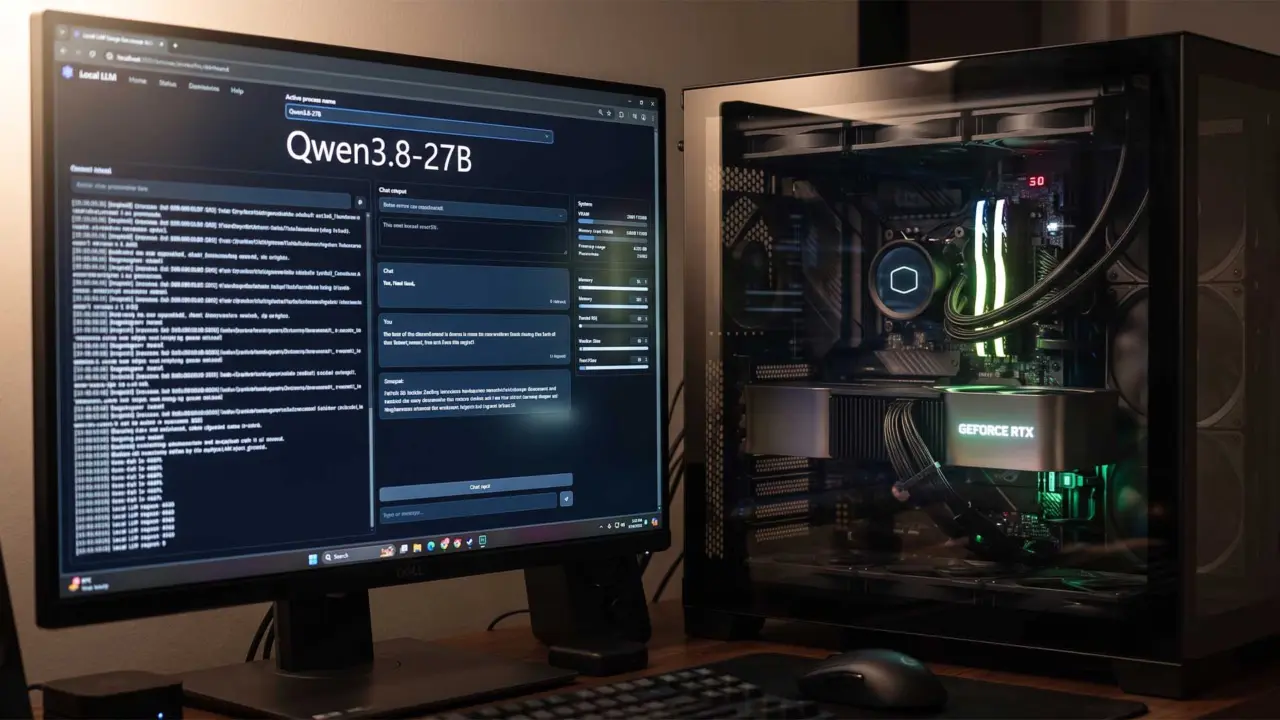
A hardware configuration trick involving NVIDIA RTX 4090 graphics cards may offer more video memory for large language models, but the method requires physical cable switching. Users running AI workloads often hit memory limits that prevent them from loading larger models, so any technique that recovers even a few gigabytes of VRAM matters for practical deployment. This approach suggests that display output routing directly impacts the available memory for compute tasks, which could change how we set up local AI rigs.
Physical cable switching doubles context window for Qwen3.8-27B
The core of the claim comes from a Reddit user who connected his external monitor to the motherboard integrated GPU instead of the RTX 4090. This user reported that moving the display signal freed up 2.5GB of VRAM on the dedicated card. The extra memory allowed the system to run the Qwen3.8-27B model with a context window of 132K tokens. This is double the 65K context window the user could achieve when the display was connected directly to the RTX 4090.
- VRAM: 24GB
- Model: Qwen3.8-27B
- Context Window: 132K
- Token Generation Speed: 125
The user, identified as u/Reklaw12, shared his findings in a post titled "PSA: Use your iGPU for display to save VRAM." He noted that the token generation speed reached 125 tokens per second during these tests. The theory relies on the fact that the RTX 4090 reserves a portion of its 24GB VRAM for display output when connected to a monitor. Routing the display through the integrated GPU removes this reservation from the dedicated card's pool.
Community skepticism remains high because other users have reported different results. Another user, HighSeasArchivist, tried a similar setup with the Qwen3.7-27B model and found that moving to the internal GPU only freed 1GB of VRAM. This result was significantly lower than the 2.5GB claimed by the first user. The discrepancy may stem from how different CPU and motherboard configurations handle PCIe lanes when the iGPU is active. Additionally, the method requires physically unplugging and replugging HDMI cables to switch between gaming and AI workloads, which is inconvenient for daily use.
The validity of the 2.5GB VRAM gain remains unverified without video demonstration or independent testing. We will treat the specific numbers with caution until more users confirm the results across different hardware setups. The practical takeaway is that display routing can affect VRAM availability, but the magnitude of the gain varies. Users interested in maximizing local LLM performance should test this configuration on their own systems before committing to the cable-switching workflow.
Discussion
0 comments
Log in to join the thread with a thoughtful take, question, or correction.